The Essential Guide to SIP Phone Service in 2025
Discover the essential guide to SIP phone service in 2025 Learn SIP basics benefits implementation security and future trends to future proof your business communication
Iacopo Bonandi, Founder & CEO
November 10, 2025Business communications are evolving at a record pace, and 2025 marks a turning point for organizations seeking smarter solutions. Companies need scalable, cost-effective, and future-ready tools to stay ahead, which is why sip phone service is in the spotlight.
This essential guide cuts through the complexity, showing how sip phone service enables modern voice, video, and messaging. Learn why it outpaces traditional phone systems, and how it can transform your operations.
Get ready to explore the fundamentals, key benefits, easy implementation steps, robust security, and the future trends shaping business telephony. Make informed decisions and unlock seamless communication for your team.
Understanding SIP Phone Service: The Fundamentals
Communication technology keeps evolving, and understanding sip phone service is crucial for businesses aiming to stay ahead. This section breaks down the essentials, helping you grasp how SIP works, its key components, and why it outpaces traditional phone systems for modern organizations.
What is SIP and How Does It Work?
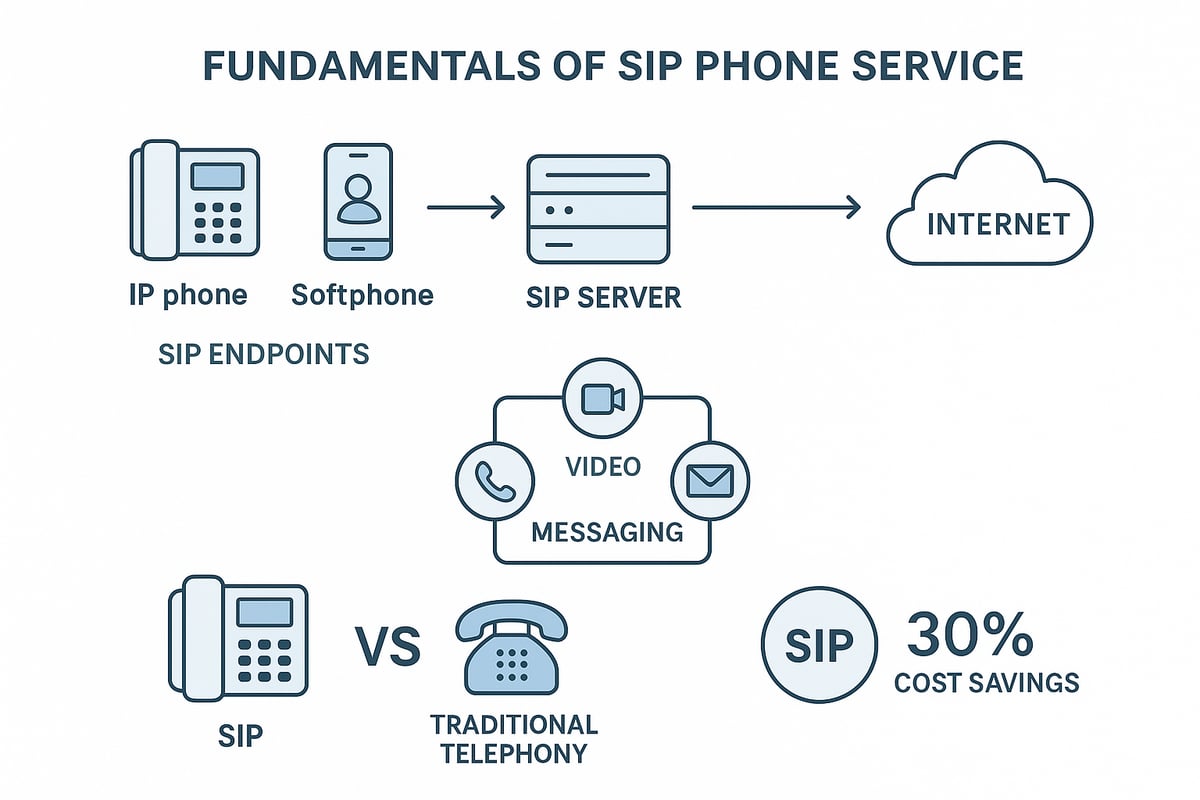
Session Initiation Protocol, known as SIP, is a signaling protocol that powers sip phone service by enabling voice, video, and messaging over the internet. Unlike traditional phone lines that rely on physical circuits, SIP creates virtual pathways, transmitting data packets via IP networks.
SIP establishes, manages, and terminates sessions between endpoints, making real-time voice calls and video conferences possible. For example, a team can hold a video meeting with colleagues worldwide using SIP, enjoying seamless, high-quality communication. As the backbone of most VoIP systems, SIP is foundational to modern business telephony.
For a deeper dive into SIP fundamentals, see the SIP phone system basics guide.
Key Components of SIP Phone Service
A sip phone service setup consists of several critical parts:
- SIP endpoints: Devices like IP phones, softphones, and PBX systems that users interact with.
- SIP servers: Handle registration, authentication, and call routing.
- SIP trunks: Virtual lines connecting business phone systems to the PSTN.
- Internet connectivity: Reliable bandwidth is essential for quality calls.
For instance, a global business can use SIP trunks to connect offices across continents, ensuring unified communications and efficient collaboration.
SIP Phone Service vs. VoIP vs. Traditional Telephony
Sip phone service uses SIP as its underlying protocol, while VoIP refers broadly to any voice transmission over IP networks. Essentially, SIP is the engine behind many VoIP solutions.
Compared to legacy PBX and analog systems, sip phone service offers flexibility and scalability. Businesses can adjust lines and features without major hardware changes, reducing costs significantly. For example, a small business upgrading from analog lines to SIP-based VoIP can scale communication effortlessly and manage resources more effectively.
Advantages of SIP Phone Service in 2025
Sip phone service delivers compelling benefits:
- Cost savings: No need for expensive hardware or on-site maintenance.
- Scalability: Instantly adjust the number of lines as business needs change.
- Unified communications: Integrate voice, video, SMS, and collaboration tools.
- Remote work support: Connect distributed teams seamlessly.
Statistics show that businesses switching to sip phone service can cut communication costs by up to 40 percent compared to traditional systems.
Common SIP Phone Service Use Cases
Sip phone service is popular among businesses of all sizes:
- SMEs and large enterprises: Connect multiple locations with centralized management.
- Call centers: Handle high call volumes and multi-channel communications.
- Remote teams: Ensure secure, reliable collaboration from anywhere.
These use cases highlight why sip phone service is the choice for modern, agile organizations.
Key Benefits of SIP Phone Service for Modern Businesses
Adopting SIP phone service unlocks a range of transformative advantages for organizations navigating the evolving landscape of business communication. The flexibility, integration, and cost savings offered by SIP phone service make it an essential tool for businesses in 2025. Let us explore the core benefits that position SIP phone service as the backbone of modern telephony.
Cost Efficiency and ROI
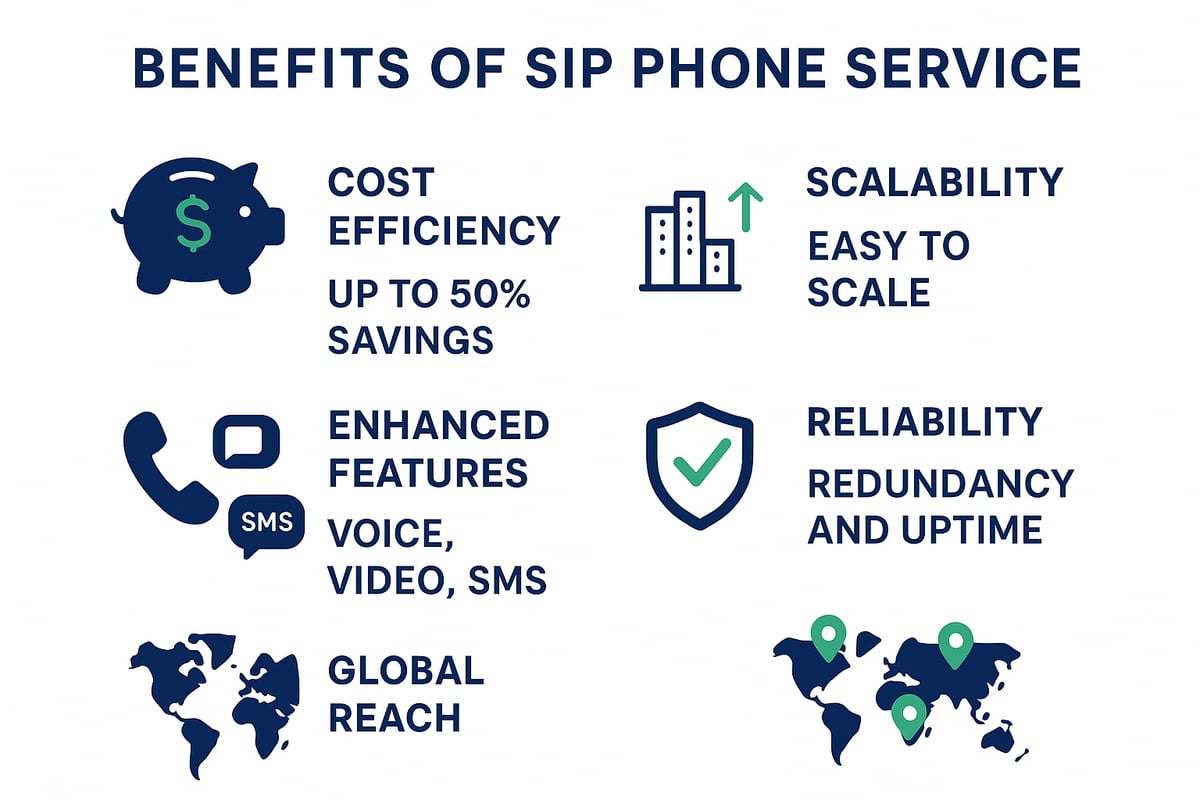
One of the most compelling benefits of SIP phone service is its ability to dramatically reduce communication costs. By eliminating the need for expensive physical phone lines and ongoing hardware maintenance, businesses can streamline their telephony expenses. SIP phone service typically uses pay-as-you-go or subscription pricing, making monthly costs predictable and scalable.
For example, companies often report saving 30% to 40% compared to legacy phone systems, especially when factoring in international calling and hardware upgrades. These savings can be even more substantial for organizations with high call volumes or multiple locations. For those seeking to maximize ROI, exploring Cheapest SIP trunk provider options can help identify affordable solutions tailored to specific business needs.
| Traditional PBX | SIP Phone Service |
|---|---|
| High upfront costs | Minimal setup fees |
| Expensive maintenance | Lower ongoing costs |
| Limited scalability | Flexible, scalable plans |
Scalability and Flexibility
SIP phone service enables businesses to scale their communication infrastructure effortlessly. Adding or removing lines does not require physical installations, so organizations can adapt quickly to changing needs. Whether expanding during periods of growth or downsizing in challenging times, SIP phone service provides the agility modern businesses require.
Retailers, for instance, can temporarily increase SIP lines during peak seasons and scale back afterward. This flexibility ensures businesses only pay for what they use, optimizing operational efficiency and resource allocation. The ability to support remote and hybrid workforces further enhances the adaptability of SIP phone service.
Enhanced Communication Features
SIP phone service brings together multiple communication channels into a unified platform. Businesses benefit from integrated voice, video, SMS, and file sharing, all accessible through a single interface. Advanced call management features, such as call forwarding, auto-attendant, and voicemail-to-email, empower teams to handle customer interactions efficiently.
Integration with CRM, helpdesk, and collaboration tools means SIP phone service streamlines workflows and boosts productivity. Sales teams, for example, can engage customers seamlessly, leveraging real-time insights and rapid response capabilities. Unified communications foster better collaboration and a more connected workforce.
Reliability and Business Continuity
Reliability is a cornerstone of SIP phone service. Built-in redundancy and failover mechanisms ensure that calls remain uninterrupted, even during network disruptions or local outages. SIP phone service can automatically reroute calls to alternate locations or devices, maintaining uptime and minimizing business impact.
For instance, organizations with multiple offices can rely on SIP phone service to keep communication channels open during emergencies. This level of business continuity is crucial for customer support, sales, and operational teams who depend on reliable connectivity to serve clients and partners.
Global Reach and Mobility
SIP phone service empowers businesses to operate seamlessly across borders. With support for local and international numbers, companies can establish a presence in new markets and make it easy for customers to connect. Remote and distributed teams benefit from consistent, high-quality communication regardless of location.
Multinational corporations use SIP phone service to unify global operations, ensuring that every office and employee remains connected. The ability to manage communications from anywhere enhances mobility, supports hybrid work models, and positions businesses for success in an increasingly digital world.
SIP Phone Service Implementation: Step-by-Step Guide
Implementing sip phone service can transform business communications, but success depends on careful planning and execution. This step-by-step guide walks you through each stage, from evaluating your current setup to ongoing optimization. By following these steps, organizations can unlock the full benefits of sip phone service while minimizing risks and disruptions.
Step 1: Assessing Business Needs and Readiness
Begin by analyzing your current telephony infrastructure and identifying pain points. Does your business rely on outdated analog lines or legacy PBX systems? List your must-have features, such as call volume, remote access, or integrations with collaboration tools.
Next, evaluate your network’s internet bandwidth. Sip phone service depends on reliable, high-speed connectivity to ensure clear voice and video communication. Use a readiness checklist:
- Inventory existing phones and PBXs
- Measure average and peak call volumes
- Assess network speed and reliability
- Identify essential integrations (CRM, helpdesk)
Addressing these factors early ensures your sip phone service rollout is seamless and effective.
Step 2: Choosing the Right SIP Provider
Selecting a sip phone service provider is crucial to long-term success. Look for providers with a reputation for reliability, transparent pricing, and robust technical support. Review their global coverage and confirm they offer clear service-level agreements (SLAs).
When comparing options, ask about:
- Uptime guarantees and redundancy
- Support response times and escalation procedures
- Pricing structure (pay-as-you-go or subscription)
- Compliance with local and international regulations
A provider that aligns with your business goals and technical needs will help your sip phone service deliver consistent results.
Step 3: SIP Hardware and Software Selection
Consider the hardware and software required for sip phone service. Options include IP desk phones for office use, softphones for computer or mobile access, and PBX systems - either on-premise or cloud-based.
Check compatibility with your existing infrastructure. For example, if you’re migrating from a legacy PBX, ensure your new devices and software support SIP protocols. Many businesses adopt cloud PBX solutions for flexibility and easier management.
Choosing the right mix of hardware and software allows your sip phone service to adapt as your organization evolves.
Step 4: Network Preparation and Security
A reliable network is the backbone of effective sip phone service. Start by confirming your bandwidth meets the demands of concurrent calls and data traffic. Implement Quality of Service (QoS) to prioritize voice packets and reduce jitter or latency.
Configure firewalls and ensure Network Address Translation (NAT) settings do not block SIP traffic. Enable SIP Application Layer Gateway (ALG) if necessary. Security measures should include:
- Strong authentication and password policies
- Encryption (TLS/SRTP) for voice and signaling data
- Monitoring for unusual activity or fraud attempts
A secure, well-prepared network supports uninterrupted sip phone service.
Step 5: SIP Trunk Configuration and Number Porting
Set up SIP trunks to connect your business to the public switched telephone network (PSTN). SIP trunks act as virtual phone lines, supporting multiple concurrent calls and easy scalability.
The number porting process lets you retain existing phone numbers when switching to sip phone service. Plan for regulatory timelines and coordinate with both your old and new providers to minimize downtime. Seamless configuration is possible with careful planning.
For insights into market trends and the strategic importance of SIP trunking, review this SIP Trunking Market Analysis.
Step 6: Testing and Training
Before fully launching sip phone service, conduct thorough testing. Make test calls to internal and external numbers, check call quality, and verify advanced features like voicemail-to-email or call forwarding.
Provide training for employees on new devices and interfaces. Well-trained users can quickly adapt to the sip phone service platform, reducing support requests and improving productivity.
Step 7: Ongoing Management and Optimization
Continuous monitoring is essential for maximizing the value of your sip phone service. Track call quality metrics such as latency, jitter, and packet loss. Use built-in analytics to review usage and identify cost-saving opportunities.
Regularly update hardware and software to access new features and maintain security. Adjust call routing or add new lines as your business grows or changes, ensuring your sip phone service remains aligned with organizational needs.
VoIPStore: Global SIP and VoIP Solutions
VoIPStore offers enterprise-grade sip phone service with coverage in more than 190 countries. Their unified API connects multiple global carriers, ensuring reliable and scalable communications for businesses of any size.
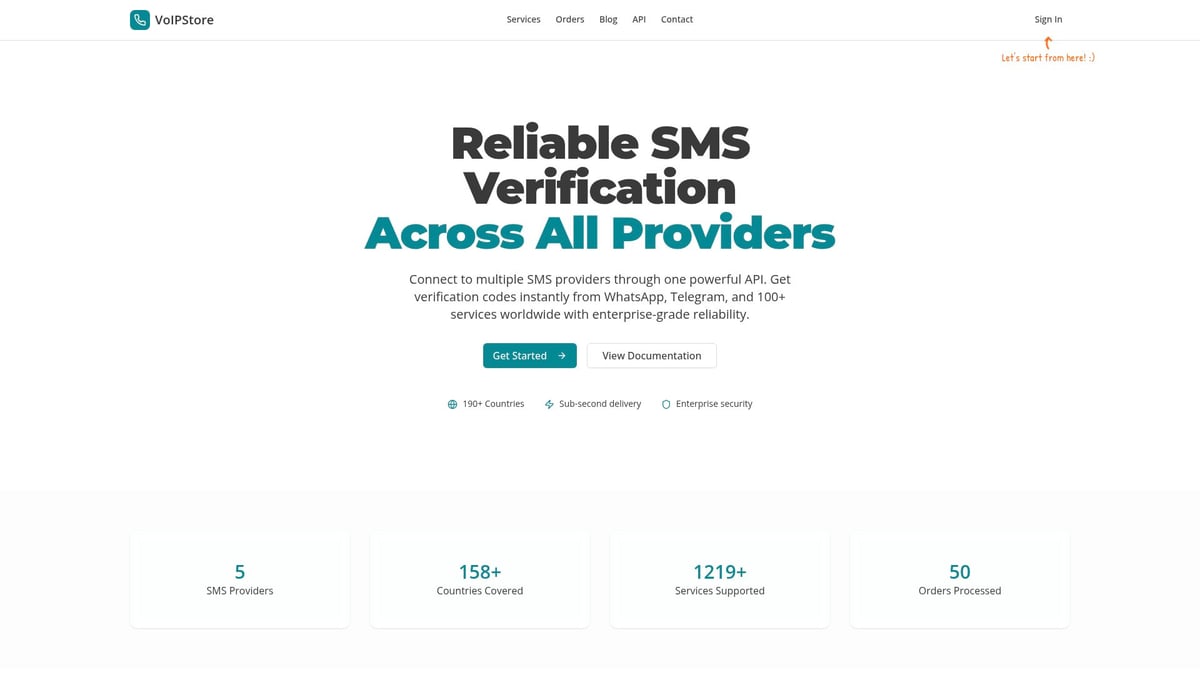
With real-time analytics, VoIPStore helps optimize costs and monitor performance. Their developer-friendly tools simplify integration, while dedicated support teams provide guidance through every stage of deployment. International businesses trust VoIPStore for secure, seamless sip phone service connections that support growth and innovation.
Security, Compliance, and Reliability in SIP Phone Service
Securing business communications is crucial as more organizations rely on sip phone service for daily operations. This section explores how to protect your network, ensure regulatory compliance, and maintain reliable connectivity in a rapidly evolving landscape.
SIP Security Threats and How to Prevent Them
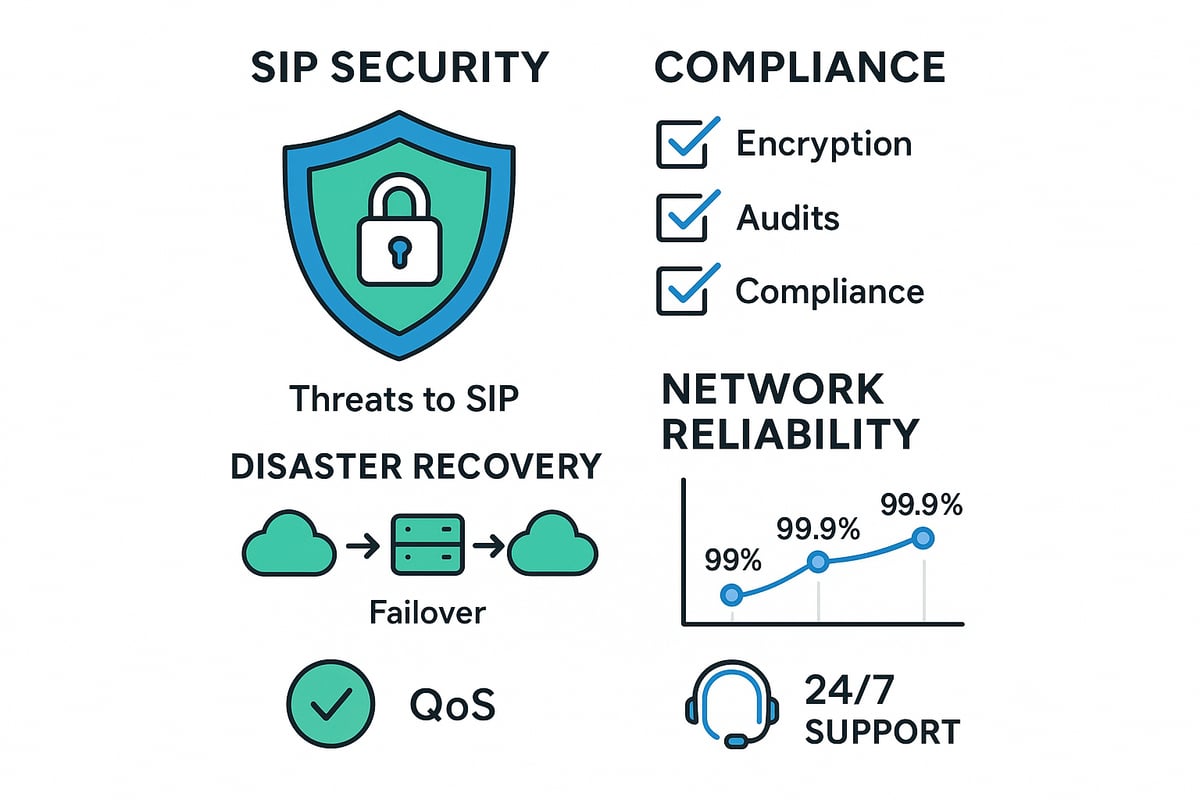
Sip phone service faces several security threats that businesses must address proactively. Common risks include toll fraud, where attackers exploit systems to make unauthorized calls, eavesdropping on unencrypted calls, and denial of service (DoS) attacks that disrupt operations.
To protect your sip phone service, implement strong authentication protocols, enable TLS and SRTP encryption, and perform regular security audits. Employ intrusion detection systems and restrict access based on IP addresses.
For example, a mid-sized company mitigated SIP fraud by enabling two-factor authentication and monitoring call patterns for anomalies. Prioritizing layered security is essential for safeguarding business communications.
Ensuring Regulatory Compliance
Regulatory compliance is a core requirement for any sip phone service implementation. Businesses must adhere to laws such as GDPR, HIPAA, and local telecom regulations, which govern data privacy and security.
Choose providers who offer compliance support, including encryption, secure data storage, and lawful interception capabilities. Data residency and privacy should be clearly documented. For more details on compliance and data protection, see this guide to SIP security and HIPAA compliance.
A healthcare provider using sip phone service achieved HIPAA compliance by enabling encrypted communications and maintaining audit trails. Regular reviews of your provider’s compliance certifications are recommended.
Disaster Recovery and Redundancy
Business continuity is vital, and sip phone service can support robust disaster recovery strategies. Use multiple SIP trunks and geographically redundant servers to ensure communications remain available during network failures or outages.
Cloud-based solutions offer automated failover, while on-premise systems may require manual intervention. Regularly test your disaster recovery plan to confirm that calls can be rerouted seamlessly.
For example, a logistics firm maintained uninterrupted service during a regional outage by leveraging sip phone service redundancy. Proactive planning ensures minimal disruption during unexpected events.
Quality of Service (QoS) and Call Reliability
Maintaining high call quality is a top priority for any sip phone service. Network congestion, jitter, latency, and packet loss can all impact voice clarity and reliability.
Implement QoS policies to prioritize voice traffic, use monitoring tools to detect performance issues, and optimize bandwidth allocation. Regular maintenance and network assessments help prevent degraded call quality.
A call center relying on sip phone service ensured crystal-clear conversations even during peak periods by deploying QoS and real-time monitoring. Consistent oversight keeps communications smooth and professional.
Provider SLAs and Support
Selecting a provider with strong service-level agreements (SLAs) is essential for reliable sip phone service. SLAs should outline uptime guarantees, response times, and escalation procedures.
Look for 24/7 technical support, proactive network monitoring, and transparent reporting. A responsive support team can quickly resolve issues and minimize downtime.
For instance, a financial services firm avoided major disruptions thanks to its provider’s dedicated sip phone service support. Clear SLAs and expert assistance are key to business success.
SIP Phone Service Trends and Innovations for 2025
The landscape of business communication is transforming quickly, and 2025 marks a year of significant change for sip phone service. With enterprises demanding smarter, more efficient connectivity, new trends are shaping how organizations deploy and use sip phone service solutions. According to VoIP User and Market Statistics, global adoption of SIP-based platforms continues to accelerate, driven by digital transformation, remote work, and the need for unified communications. Let’s explore the innovations redefining sip phone service in 2025.
AI and Automation in SIP Communications
Artificial intelligence is revolutionizing sip phone service by automating tasks that once required manual intervention. AI-powered call routing allows incoming calls to be directed based on intent, caller history, or even sentiment analysis, reducing wait times and improving customer satisfaction. Virtual assistants can answer common queries or route calls more efficiently, freeing up human agents for complex cases.
Speech analytics tools integrated with sip phone service monitor conversations for quality, compliance, and actionable insights. Automated troubleshooting and self-healing networks proactively detect and resolve issues, minimizing downtime. Businesses leveraging AI in their sip phone service report greater efficiency, better customer experiences, and reduced operational costs.
Integration with Collaboration and Productivity Platforms
In 2025, sip phone service is no longer isolated from the broader digital workspace. It now seamlessly integrates with platforms like Microsoft Teams, Slack, and Google Workspace, allowing users to transition between calls, video meetings, and messaging within a single environment. This convergence streamlines workflows and boosts productivity, especially for distributed teams.
SIP-enabled unified communications platforms support voice, video, file sharing, and real-time collaboration without the friction of switching apps. For example, remote teams can initiate a video call from a Slack channel using sip phone service, keeping conversations organized and accessible. These integrations ensure that communication remains agile and adaptable to changing business needs.
5G and Edge Computing Impact
The rollout of 5G networks and advances in edge computing are dramatically enhancing sip phone service quality and reliability. With higher bandwidth and ultra-low latency, 5G enables crisp voice and video calls, even for mobile and remote users. Edge computing processes data closer to the user, reducing delays and strengthening security for sensitive communications.
For organizations with a mobile workforce, sip phone service powered by 5G supports real-time collaboration and uninterrupted connectivity. According to SIP Trunking Trends in 2025, businesses are adopting multi-access edge computing (MEC) to optimize call routing and ensure business continuity in any scenario. This trend is setting a new standard for performance and resilience.
Advanced Security and Compliance Solutions
Security in sip phone service is evolving rapidly to address new threats and stricter compliance requirements. Zero-trust security models verify every user and device before granting access, while advanced encryption protocols such as TLS and SRTP protect calls from interception and tampering. Biometric authentication is also gaining traction, adding another layer of identity verification.
Automated compliance monitoring helps organizations meet regulatory requirements in sectors like finance and healthcare. Real-time alerts and detailed reporting ensure that sip phone service remains both secure and auditable. As cyber risks grow, these innovations provide peace of mind and safeguard sensitive business communications.
The Rise of API-Driven SIP Services
Developers and enterprises are increasingly turning to API-driven sip phone service solutions for customization and agility. Through programmable APIs, businesses can tailor features, automate workflows, and integrate calling capabilities into proprietary apps or customer platforms. Real-time analytics delivered via APIs empower organizations to optimize call routing, monitor usage, and improve customer engagement.
SaaS providers are embedding sip phone service directly into their offerings, enabling clients to manage communications within the same interface as their core business tools. This shift toward API-centric design is accelerating innovation, allowing businesses to respond quickly to market demands and deliver differentiated experiences.
Frequently Asked Questions about SIP Phone Service
Curious about sip phone service and how it can transform your business communications? Explore these common questions and answers to gain clarity and confidence as you consider next steps.
What is a SIP phone service and how is it different from VoIP?
SIP phone service uses the Session Initiation Protocol to manage multimedia communication sessions, including voice, video, and messaging, over the internet. While VoIP broadly refers to any voice transmitted over IP networks, sip phone service specifically relies on SIP to establish, maintain, and terminate these connections.
SIP enables advanced features like video conferencing and instant messaging, making it more versatile than traditional VoIP. For a deeper dive into the differences, see this VoIP phone service comparison.
What hardware or software do I need for SIP phone service?
To get started with sip phone service, you need compatible devices such as IP phones, softphones (software-based phones), or SIP-enabled PBX systems. Many businesses opt for cloud-based solutions, which reduce the need for on-premise equipment and simplify management.
Softphones are ideal for remote teams, while dedicated IP phones provide a traditional desk phone experience. Assess your current infrastructure to determine which combination best suits your needs.
How secure is SIP phone service?
Security is a top priority with sip phone service. Providers implement strong encryption protocols like TLS and SRTP to protect call data and prevent eavesdropping. Authentication measures and regular security audits help defend against common threats such as toll fraud and denial-of-service attacks.
Choosing a reputable provider and following best practices, like enabling multi-factor authentication, further strengthen your security posture. Consistent updates ensure you stay ahead of emerging risks.
Can I keep my existing phone numbers when switching to SIP?
Porting your existing numbers to a new sip phone service is typically straightforward. Most providers support number porting, allowing you to retain business continuity and avoid confusion for your customers.
The process may take a few days to a couple of weeks, depending on regulatory requirements and your previous carrier. Work with your new provider to ensure a smooth transition and minimal downtime during the switch.
What are typical costs and savings with SIP phone service?
Sip phone service offers significant cost advantages over legacy systems. You can expect to reduce expenses on hardware, maintenance, and long-distance calls. Most providers offer flexible pay-as-you-go or subscription pricing, making budgeting predictable.
Many businesses report savings of 30 to 40 percent compared to traditional phone systems. Analyze your current spend to estimate potential ROI and long-term benefits from adopting sip phone service.
As you look ahead to 2025 and consider how to future proof your business communications, it’s clear that SIP phone service offers unmatched flexibility, global reach, and cost efficiency. With features like real time analytics, seamless integration with popular platforms, and enterprise grade reliability, you’re positioned to keep your team connected - no matter where they are. If you’re ready to take the next step and experience the power of unified communications, you can easily get started with VoIPStore’s trusted SIP and VoIP solutions. Join professionals worldwide who are already making the switch - Start now!
Ready to receive a verification code on a real mobile number?
Browse services