Enterprise VoIP Guide: Unlocking Business Communication 2025
Discover the enterprise VoIP essentials for 2025. Learn features, benefits, implementation steps, and future trends to unlock secure, scalable business commu
Iacopo Bonandi, Founder & CEO
October 29, 2025Enterprise VoIP is at the center of a rapid transformation in business communications. As we approach 2025, organizations face pivotal choices in how they connect global teams across hybrid and remote work environments.
The demand for scalable, flexible, and cost-effective solutions is greater than ever. Modern platforms are redefining productivity, enabling seamless collaboration, and giving businesses the agility to thrive in a digital-first world.
This guide will walk you through every step of leveraging enterprise VoIP in 2025. We will explore its evolution, essential features, implementation strategies, benefits, future trends, and how to choose the right solution for your enterprise.
Understanding Enterprise VoIP: Definition, Evolution, and Core Concepts
Enterprise VoIP is transforming how organizations connect and collaborate worldwide. As businesses expand and workforces become more distributed, understanding the fundamentals of enterprise VoIP is crucial for making informed decisions in 2025. Let’s break down what sets enterprise VoIP apart, how it has evolved, and how it functions in today’s digital landscape.
What Is Enterprise VoIP?
Enterprise VoIP refers to a voice communication system designed for organizations with complex, high-volume needs. Unlike standard VoIP for consumers, enterprise VoIP supports multi-location operations and integrates with unified communications, including video, chat, and contact centers.
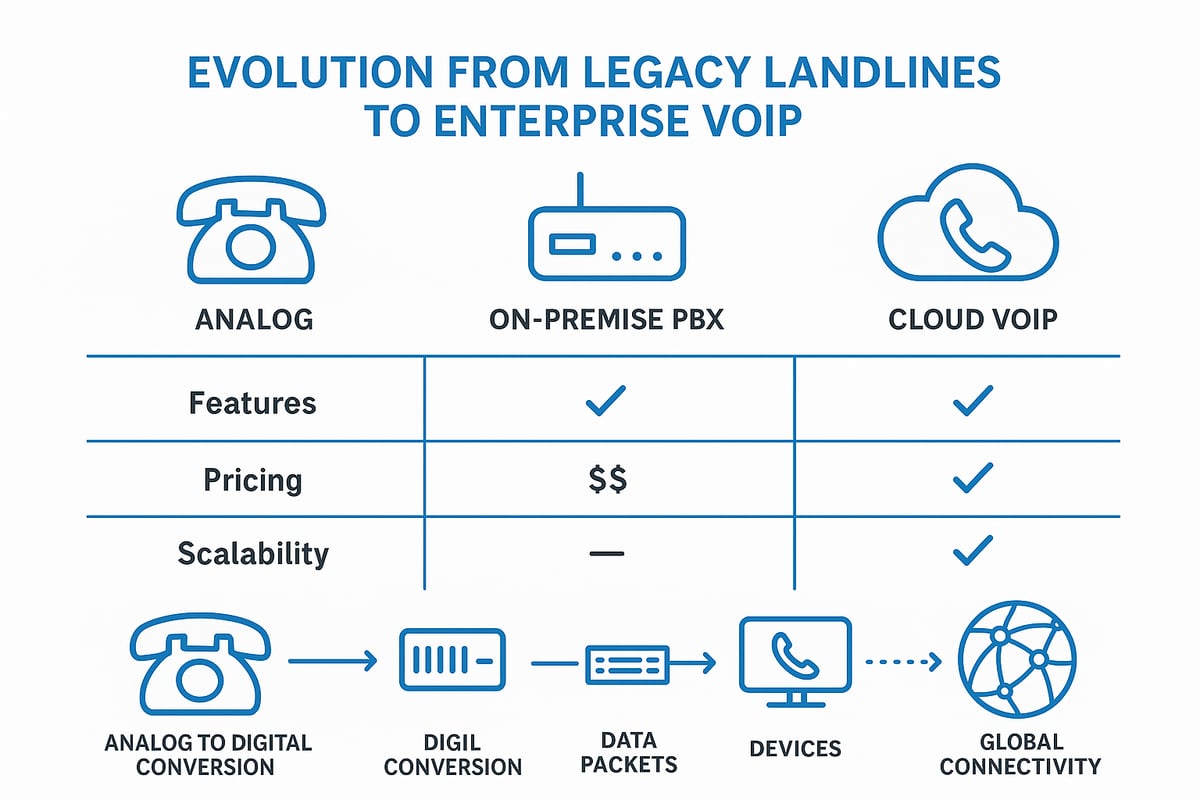
This technology uses internet protocols to transmit voice and data, replacing traditional landlines that rely on public switched telephone networks. The shift from on-premise PBX hardware to cloud platforms has unlocked scalability, flexibility, and lower maintenance demands for enterprises.
Modern enterprise VoIP solutions also offer seamless integration with business applications and support advanced features, such as call analytics and real-time collaboration. For example, legacy landlines require physical wiring and dedicated hardware, while enterprise VoIP enables deployment across devices with minimal setup and rapid scaling.
The adoption rate for enterprise VoIP continues to climb as global workforces demand more agile communication solutions.
Key Differences: Enterprise VoIP vs. Traditional Landlines
When comparing enterprise VoIP to traditional landlines, several key differences emerge. Infrastructure for landlines depends on physical hardware and dedicated lines, while enterprise VoIP leverages cloud-based platforms that reduce on-site equipment.
Cost structures also differ significantly. Landlines often require hefty upfront investments and ongoing maintenance, whereas enterprise VoIP typically uses a subscription model that includes updates and support. Scaling is much faster with enterprise VoIP, allowing organizations to add or remove users and features instantly.
Support models have evolved as well, with enterprise VoIP providers offering 24/7 assistance and remote troubleshooting. The table below summarizes these core contrasts:
| Feature | Traditional Landlines | Enterprise VoIP |
|---|---|---|
| Infrastructure | Hardware, wiring | Cloud-based, virtual |
| Pricing | Upfront, per-line | Subscription, per-user |
| Scalability | Manual, limited | Instant, flexible |
| Support | Local, limited hours | 24/7 global, remote |
With these advantages, enterprise VoIP empowers organizations to respond rapidly to business changes and scale communication as needed.
How Enterprise VoIP Works
Enterprise VoIP operates by converting analog voice signals into digital data, transmitting them over the internet as packets, and then decoding them for recipients. This process requires three main components: a reliable broadband connection, compatible devices (desktops, mobiles, or VoIP phones), and virtual accounts managed through an admin portal.
Deployment models range from on-premise IP PBX systems to fully hosted cloud PBX and hybrid options. Enterprises can choose the best fit for their security, compliance, and scalability needs. For a deeper dive into these deployment models, see VoIP PBX System Explained.
In a real-world scenario, a distributed team can use enterprise VoIP to make calls, join meetings, and share files across multiple devices and locations. This flexibility supports global operations and remote work without sacrificing reliability or quality.
Essential Features of Modern Enterprise VoIP Solutions
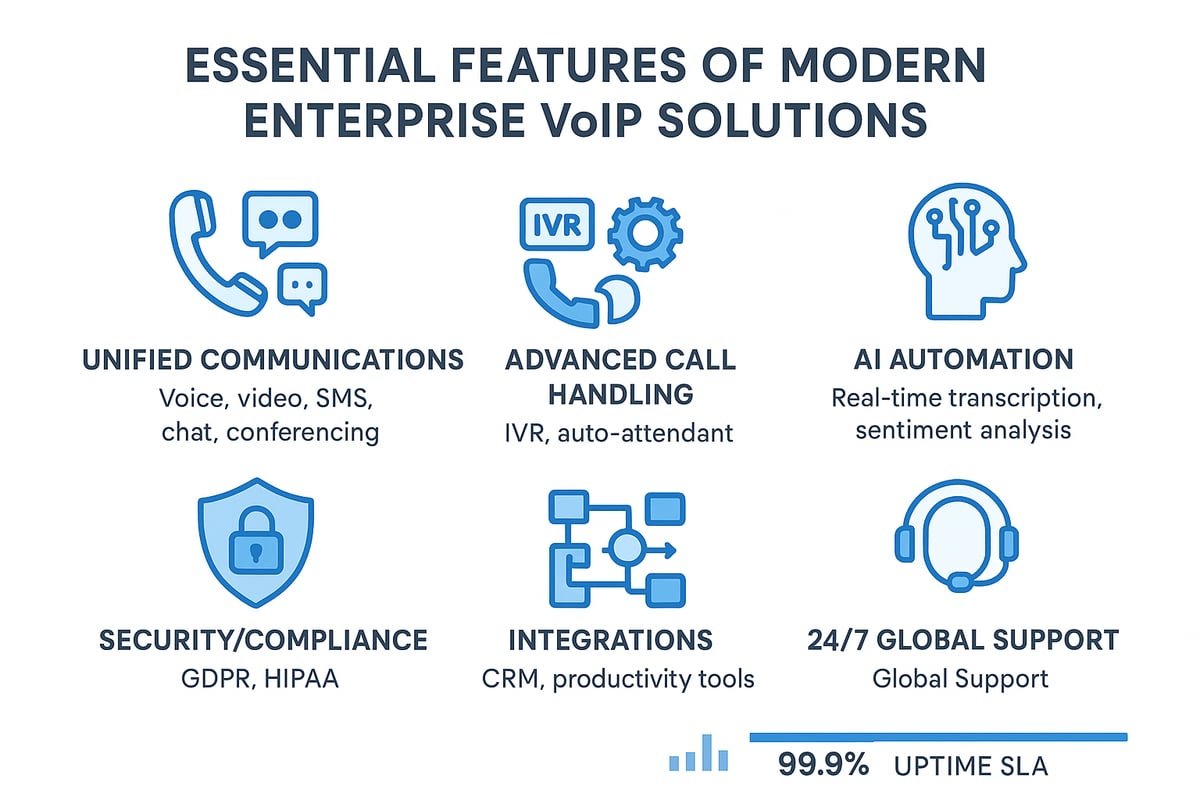
Modern enterprise voip solutions are engineered to empower businesses with flexibility, scalability, and advanced communications. These platforms offer a comprehensive set of tools that unify collaboration, automate workflows, and secure sensitive information, all while supporting global operations.
Unified Communications Capabilities
Enterprise voip platforms consolidate voice, video, SMS, chat, and conferencing into a single, unified interface. This integration enables businesses to manage all communications from one platform, reducing complexity and boosting efficiency.
With omnichannel experiences, teams can seamlessly switch between channels, making collaboration with colleagues and clients frictionless. For global teams, unified communications streamline workflows and eliminate the need for multiple apps, supporting productivity across time zones.
Advanced Call Handling and Routing
Advanced call handling is a cornerstone of enterprise voip. Features such as auto-attendants, interactive voice response (IVR), call forwarding, and visual voicemail automate and customize call flows.
Customizable call routing ensures that calls reach the right person or department quickly, enhancing customer satisfaction. A real-world example is a support center that reduced wait times by deploying intelligent routing, resulting in quicker resolutions and improved service levels.
AI and Automation in VoIP
The integration of AI-powered features is rapidly transforming enterprise voip systems. Capabilities like real-time transcription, sentiment analysis, and automated meeting recaps help teams capture information and insights instantly.
Automated call distribution and agent assist tools further enhance productivity. According to AI Integration in VoIP Systems, businesses are seeing significant gains in efficiency and accuracy by leveraging these advanced AI features.
Security, Compliance, and Privacy
Security is paramount for enterprise voip solutions. Providers implement robust protocols including end-to-end encryption, single sign-on, and role-based access to safeguard communications.
Compliance with regulations such as HIPAA, GDPR, and SOC2 is standard, ensuring data privacy and legal adherence. In-meeting controls, like muting participants or removing guests, and customizable data retention policies give organizations full control over privacy and compliance.
Integration and API Ecosystem
A key strength of enterprise voip is its ability to integrate with business-critical applications. Native integrations with CRMs like Salesforce and HubSpot, productivity suites like Microsoft 365 and Google Workspace, and ticketing systems streamline operations.
Open APIs allow developers to build custom workflows and automate reporting, creating tailored solutions for unique business needs. Integrations drive efficiency by connecting communication tools directly to existing business processes.
Mobility and Device Flexibility
Enterprise voip supports seamless communication across desktop, mobile, and browser-based platforms. Employees can start a call on one device and continue it on another without interruption, supporting flexible work styles.
Hybrid teams benefit from this device flexibility, as they can collaborate from any location. This ensures consistent communication experiences whether in the office, at home, or on the move.
24/7 Global Support and Reliability
Round-the-clock, multilingual support is a standard offering in enterprise voip solutions. Providers guarantee high availability with 100 percent uptime service level agreements and automatic failover mechanisms.
These features ensure that businesses remain connected globally, with minimal risk of disruption. Industry benchmarks show that top providers consistently deliver on uptime and support responsiveness, making enterprise voip a reliable foundation for mission-critical communications.
Step-by-Step Guide: Implementing Enterprise VoIP in 2025
Adopting enterprise voip in 2025 requires a structured approach to ensure seamless integration, maximum value, and minimal disruption. This guide breaks down the process into five actionable steps, helping organizations navigate every phase with confidence and clarity.
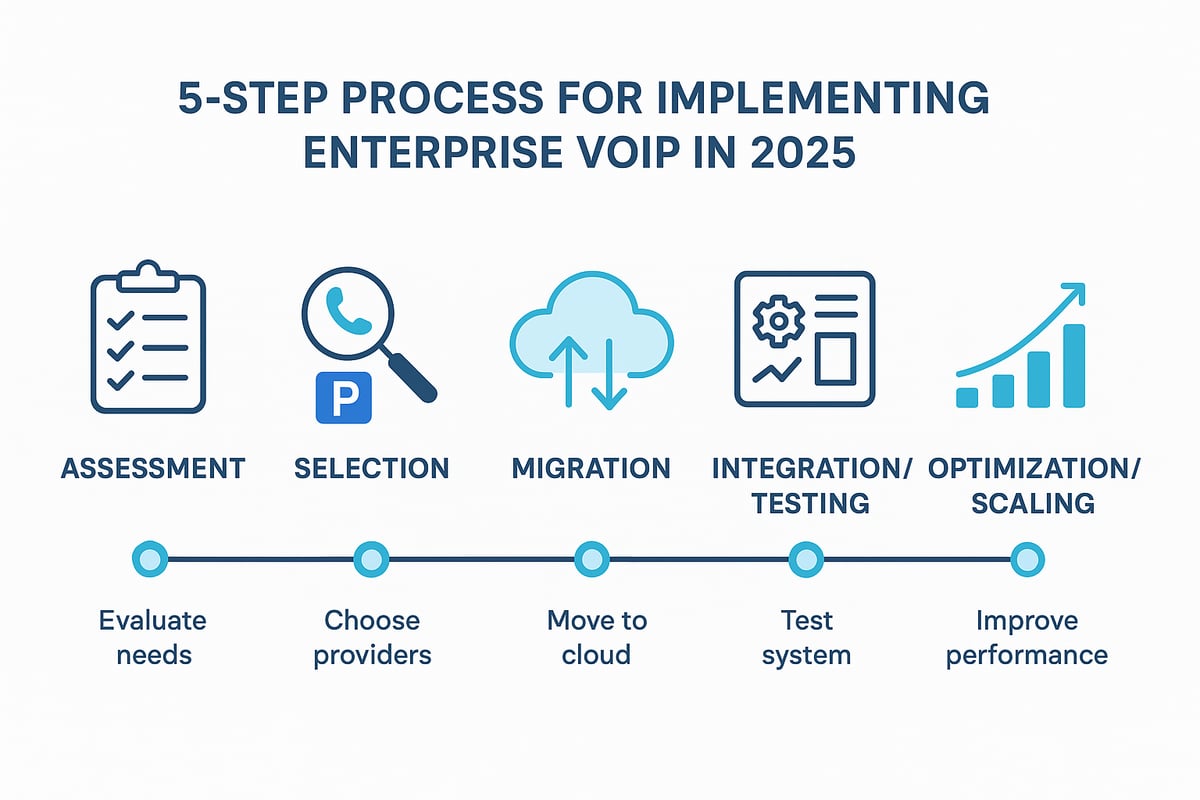
Step 1: Assess Communication Needs and Readiness
Begin your enterprise voip journey by thoroughly auditing your current communication environment. Identify existing telephony infrastructure, pain points, and limitations. Gather input from various departments to understand unique requirements for call volume, locations, integrations, and compliance needs.
Consider the shift to remote and hybrid work. Does your organization have international branches or distributed teams? Assess the need for mobility, device flexibility, and unified communications.
Key assessment points:
- Number of users and sites
- Required integrations (CRM, helpdesk)
- Regulatory compliance (HIPAA, GDPR)
- Remote or hybrid workforce support
- International calling needs
For example, a manufacturing enterprise may prioritize reliability and integration with factory systems, while a retail chain might focus on rapid scaling and omnichannel support. By mapping these needs, you set a strong foundation for successful enterprise voip deployment.
Step 2: Select the Right VoIP Solution and Provider
With your requirements mapped, evaluate which enterprise voip deployment model best fits: on-premise, hosted, hybrid, or cloud-native. Compare feature sets, scalability, integration capabilities, and security offerings across leading providers.
Prioritize vendors with strong reputations, robust compliance standards, and global support. Consider service level agreements, uptime guarantees, and multilingual support. Review pricing models to find a balance between cost and functionality.
For in-depth analysis of top solutions, explore the Best VoIP Business Phone Service guide for enterprise-level recommendations.
A financial services firm, for instance, may choose a provider with advanced encryption and real-time compliance monitoring. Take your time to demo platforms and request references from similar industries.
Step 3: Plan and Prepare for Migration
Transitioning to enterprise voip requires careful planning to avoid service disruptions. Start by creating a detailed migration timeline that coordinates with business cycles and minimizes downtime. Port existing phone numbers, set up new extensions, and configure auto-attendants.
Train staff on the new system. Offer hands-on sessions and reference guides to familiarize users with updated features and interfaces. Ensure all devices and internet connections meet minimum requirements for call quality.
An example migration checklist:
- Notify stakeholders of migration schedule
- Back up current telephony data
- Test network bandwidth and QoS settings
- Set up user accounts and permissions
Education First rapidly deployed a contact center in minutes using cloud-based enterprise voip, demonstrating the speed and flexibility of modern platforms.
Step 4: Integrate with Business Systems and Test Functionality
Once the core enterprise voip system is live, connect it to essential business tools such as CRM, helpdesk, and productivity platforms. Use APIs or built-in integrations for seamless data flow and workflow automation.
Test all call functions, including inbound and outbound calls, call routing, and failover scenarios. Validate call quality, latency, and system reliability under different conditions. Set up analytics dashboards to track usage, performance, and costs.
Real-time analytics offer insights for optimizing call handling and identifying cost-saving opportunities. By thoroughly testing integrations and features, you ensure your enterprise voip solution delivers maximum value from day one.
Step 5: Optimize, Monitor, and Scale
Implementation does not end at launch. Continuously monitor your enterprise voip usage, performance metrics, and user feedback. Leverage built-in analytics for spotting trends, managing costs, and improving call quality.
As your business grows, scale users, lines, and features instantly through admin dashboards. Add locations, enable new channels, or roll out advanced features like AI-powered transcription as needed.
Optimization checklist:
- Regularly review usage reports
- Solicit employee feedback
- Adjust routing and permissions for efficiency
- Stay updated on compliance and security practices
Competitor case studies show that proactive monitoring and agile scaling help enterprises achieve significant cost savings and operational agility with enterprise voip.
Benefits of Switching to Enterprise VoIP: Cost, Scalability, and Global Reach
Switching to enterprise voip is a strategic move for organizations seeking modern communications. From cost efficiency to global reach, the advantages are clear. Let us explore the key benefits that make enterprise voip the top choice for forward-thinking businesses in 2025.
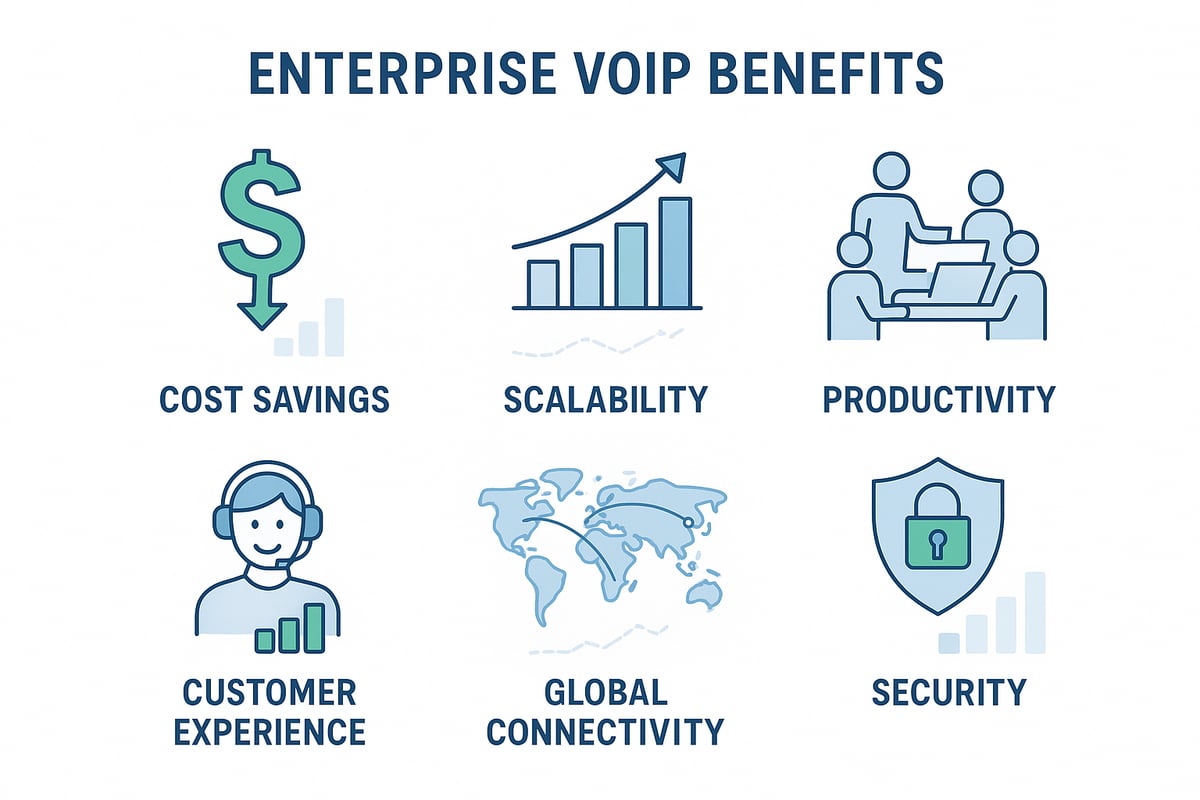
Cost Savings and Flexible Pricing
One of the most compelling reasons businesses switch to enterprise voip is the significant cost reduction. Traditional phone systems require expensive hardware and high maintenance costs. With enterprise voip, companies benefit from subscription-based pricing that eliminates large upfront investments.
Providers often include unlimited local and international calling, reducing expenses for global operations. Maintenance, upgrades, and support are handled by the provider, helping organizations avoid surprise costs. In fact, according to VoIP Adoption Among Businesses, companies report up to 60% savings on monthly communication costs with enterprise voip compared to legacy systems.
This shift allows businesses to allocate resources more effectively, supporting growth and innovation.
Scalability and Agility
Enterprise voip platforms are designed to scale effortlessly as organizations grow. Adding or removing users, phone numbers, or features is as simple as a few clicks in an admin dashboard. This flexibility is vital for companies expanding into new markets or supporting remote workforces.
Unlike traditional systems, enterprise voip does not require new hardware or complex installations when scaling. Businesses can rapidly launch new locations or adjust capacity to meet seasonal demand. As highlighted in VoIP Adoption Among Businesses, scalability is a core reason enterprises are moving to cloud communications.
This agility empowers organizations to adapt quickly to market changes and customer needs.
Enhanced Productivity and Collaboration
Enterprise voip platforms unify voice, video, messaging, and conferencing in a single solution. This streamlines workflows and reduces the need to juggle multiple apps. Teams collaborate in real time, whether in the office or across continents.
Features like presence indicators, shared contacts, and instant file sharing drive efficiency. Employees can switch seamlessly between devices and communication modes. The result is faster project delivery, fewer missed messages, and a more connected workplace.
Unified communications not only save time but also foster a culture of teamwork and innovation.
Improved Customer Experience
With enterprise voip, businesses can deliver exceptional customer service. Intelligent call routing, auto-attendants, and IVR reduce wait times and connect callers to the right person faster.
Omnichannel support helps customers reach your team via voice, SMS, chat, or video. This seamless experience increases satisfaction and boosts Net Promoter Scores. Companies that prioritize customer engagement with enterprise voip often see measurable gains in retention and loyalty.
Global Connectivity and Reliability
Enterprise voip solutions offer global coverage and 24/7 support, ensuring your business stays connected no matter where your teams operate. Providers deliver 100 percent uptime service level agreements and automatic failover for business continuity.
According to Global VoIP Market Growth Projections, demand for reliable global communication is driving enterprise voip adoption worldwide. Multilingual support and international number availability make it easy to reach customers and partners across borders.
This reliability is essential for businesses with distributed or hybrid teams.
Security and Compliance
Security is a top concern for every organization. Enterprise voip platforms include robust encryption, user authentication, and role-based access controls. These features protect sensitive data and voice traffic from threats.
Providers also support compliance with standards like HIPAA, GDPR, and SOC2. Customizable retention and consent policies help organizations meet industry regulations. For sectors like healthcare or finance, enterprise voip ensures both security and peace of mind.
Future Trends and Critical Considerations for Enterprise VoIP in 2025
The landscape for enterprise VoIP is evolving at an unprecedented pace. As we approach 2025, organizations must stay ahead by understanding the trends shaping the future of business communications. From AI-driven automation to sustainability, the next generation of enterprise VoIP solutions will transform how global teams connect, collaborate, and stay secure.
AI-Driven Automation and Analytics
Artificial intelligence is rapidly enhancing enterprise VoIP capabilities. Predictive analytics now optimize call routing, workforce management, and customer engagement. AI-powered virtual agents and chatbots handle routine inquiries, freeing human agents for complex tasks. Real-time transcription and sentiment analysis offer deeper business insights.
Industry forecasts suggest AI adoption in business communications will continue to accelerate, driving measurable productivity gains. According to the VoIP Market Size and Forecast, the global enterprise VoIP sector is set for significant growth as organizations prioritize automation and data-driven decision-making.
Expansion of Omnichannel and Unified Experiences
The modern enterprise VoIP platform integrates voice, video, messaging, and collaboration into a single, seamless experience. Omnichannel support enables customers and employees to transition effortlessly between communication modes.
Contact centers leverage these capabilities to improve first-call resolution and customer satisfaction. For global enterprises, unified experiences mean consistent service and branding across locations and channels. This trend is vital for organizations seeking to differentiate themselves in a competitive market.
Enhanced Security and Compliance Demands
Security remains a top concern for enterprise VoIP users. In 2025, compliance requirements like GDPR, CCPA, and HIPAA are becoming more stringent. Providers are investing in advanced threat detection, multi-factor authentication, and encryption by default.
Zero-trust architectures are increasingly common, ensuring that only authorized users access sensitive information. Enterprises must verify that their VoIP solution supports evolving regulatory needs and offers customizable data retention and consent controls to protect both business and customer data.
Globalization and Hybrid Workforces
Enterprise VoIP platforms are adapting to support increasingly distributed and international teams. Features like real-time translation, localization, and multilingual support help bridge communication gaps across borders.
As hybrid work models become standard, flexibility and accessibility are critical. Global organizations rely on enterprise VoIP to provide reliable, high-quality connections for remote employees, regardless of location. This adaptability empowers teams to collaborate efficiently and maintain productivity worldwide.
Open APIs, Integrations, and Customization
Customization and workflow automation are now essential for enterprise VoIP. Leading solutions offer open APIs and deep integrations with CRMs, productivity suites, and helpdesk platforms. Low-code and no-code tools allow businesses to create unique workflows tailored to their needs.
Enterprises benefit from developer support and robust documentation, enabling rapid deployment of new features and analytics dashboards. For a closer look at platforms offering advanced integrations, see Unified VoIP Solutions for Business, which highlights providers excelling in this area.
Sustainability and Green IT Initiatives
Sustainability is a growing priority for enterprise VoIP buyers. Cloud-based VoIP reduces hardware waste and energy consumption compared to traditional phone systems. By enabling remote work and minimizing travel, these solutions help lower organizational carbon footprints.
Many leading providers now report on their environmental impact and commit to green IT practices. Enterprises can align communications strategy with corporate responsibility goals by selecting VoIP partners with strong sustainability credentials.
Key Considerations for Choosing a VoIP Provider in 2025
Selecting the right enterprise VoIP provider requires a strategic approach. Use the checklist below to guide your evaluation:
| Consideration | What to Look For |
|---|---|
| Provider Reputation | Industry experience, customer reviews |
| Service Level Agreements | 100% uptime guarantees, support response times |
| Integration Capabilities | Compatibility with business-critical systems |
| Security & Compliance | Support for latest standards and regulations |
| Scalability & Flexibility | Easy user/feature expansion, global reach |
| Customization & APIs | Open API access, workflow automation options |
| Sustainability | Environmental commitments, green IT initiatives |
Ensure your enterprise VoIP solution is future-proof by prioritizing these criteria during vendor selection. This will position your organization to thrive in the evolving business communications landscape.
As you look ahead to 2025, it’s clear that modern enterprise VoIP isn’t just about making calls - it’s about connecting teams, streamlining workflows, and scaling your business with confidence. We’ve covered how the right VoIP solution gives you agility, global reach, and reliability, all while optimizing costs and supporting hybrid work. If you’re ready to unlock seamless business communication, there’s no better time to start exploring the tools that will shape your success. Take the next step toward smarter, more connected operations - Start now!
Ready to receive a verification code on a real mobile number?
Browse services