VoIP PBX System Versus Traditional PBX: 2025 Comparison
Compare VoIP PBX system and traditional PBX in 2025. Explore costs, features, security, scalability, and real use cases to choose the best solution for your business.
Iacopo Bonandi, Founder & CEO
October 21, 2025With business communications shifting faster than ever, the right phone system can make or break your company's success in 2025. Many organizations are now questioning whether to stick with traditional PBX or transition to a modern voip pbx system. In this article, you'll find a clear, unbiased comparison to guide your decision.
We'll break down what each system is, explore their technologies, costs, features, scalability, and security. You'll also see real-world examples and industry trends. Don't let outdated communication tools hold your business back - discover which PBX approach fits your needs and take the next step to future-proof your operations.
Understanding PBX Systems: VoIP vs. Traditional
Selecting the right business phone system starts with understanding how PBX technologies have evolved. Today, companies can choose between traditional PBX and the modern voip pbx system, each offering distinct benefits and limitations.
What is a Traditional PBX System?
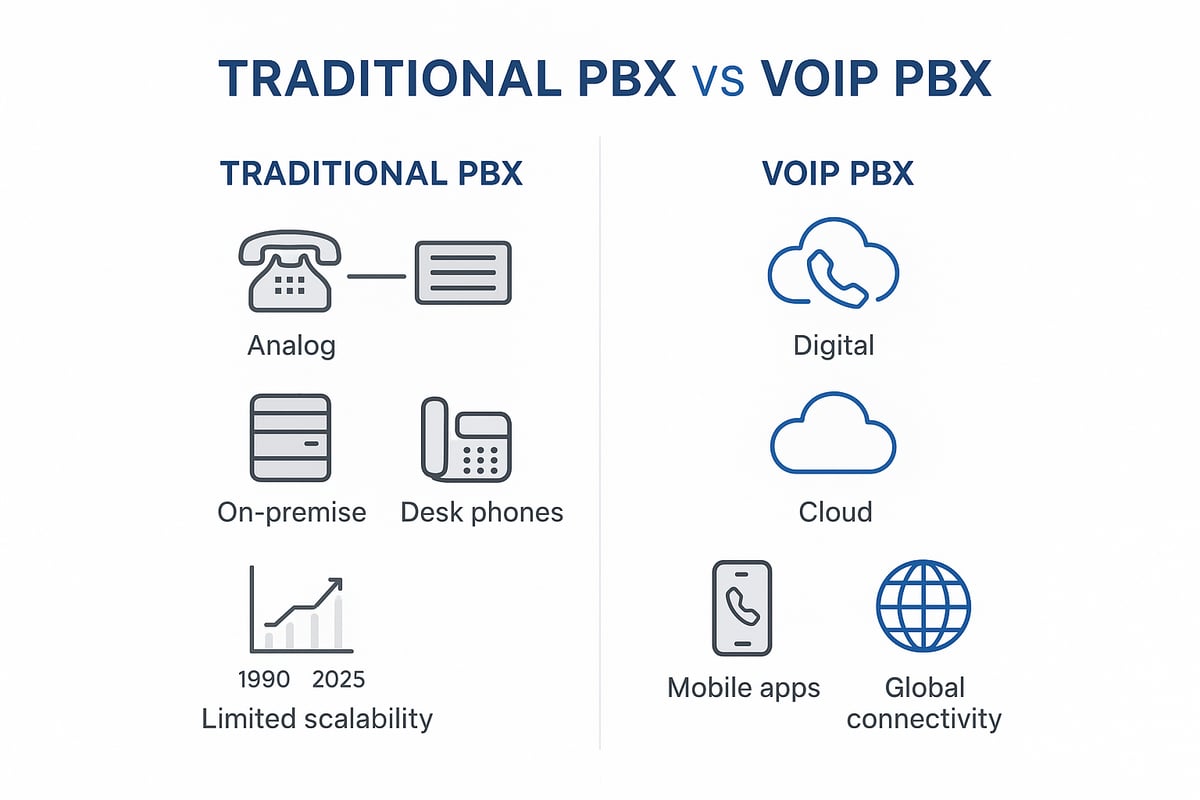
A traditional PBX (Private Branch Exchange) is an on-premise phone system that connects internal desk phones to each other and the public telephone network using physical switchboards and copper wiring. This setup relies on circuit-switched telephony, meaning each call occupies a dedicated line during the conversation.
Medium and large enterprises often use traditional PBX, especially those with established office locations and legacy infrastructure. Key components include phone lines, hardware switchboards, and analog desk phones.
For example, a law firm operating since the 1990s may still use an analog PBX, maintaining a reliable but rigid communication setup. However, traditional PBX systems face limitations such as geographical constraints and minimal support for remote work or mobile integration.
What is a VoIP PBX System?
A voip pbx system operates using Internet Protocol, handling voice calls as digital data packets instead of analog signals. These systems can be cloud-hosted or deployed on-premise, offering flexibility for businesses of all sizes.
Core technologies include SIP (Session Initiation Protocol), softphones, mobile apps, and web-based clients. Companies with remote teams, startups, or global operations often select voip pbx system solutions for their adaptability and integration options.
For instance, a tech startup might deploy a platform like 3CX or Nextiva to support hybrid work and streamline communication. VoIP PBX stands out for its easy scalability, seamless integration, and advanced features. To learn more, see this VoIP PBX systems overview.
Key Differences in Core Technology
Understanding the core differences between a traditional PBX and a voip pbx system helps clarify which is best for your needs.
| Feature | Traditional PBX | VoIP PBX System |
|---|---|---|
| Transmission | Analog (copper lines) | Digital (internet-based) |
| Hardware | Physical switchboard | Virtual/cloud-based |
| Call Routing | Manual/physical | Automated/intelligent |
| Integrations | Limited | CRM, email, messaging |
| Upgradability | Complex, costly | Simple, future-proof |
Traditional PBX relies on analog technology and physical infrastructure, limiting integration with modern tools and making upgrades expensive. In contrast, a voip pbx system uses digital transmission, enabling advanced call routing, easy upgrades, and seamless integration with business software.
Industry data highlights a clear trend: adoption of voip pbx system solutions is rising rapidly, while legacy PBX usage continues to decline. This shift is driven by the growing need for flexibility, remote work support, and cost efficiency.
Cost Comparison: Upfront, Ongoing, and Hidden Expenses
Selecting the right phone system requires a clear understanding of the true costs involved. Both traditional PBX and a voip pbx system have unique expense structures, from installation to hidden fees. Let's break down each cost factor to help you budget wisely and avoid surprises.
Initial Setup and Hardware Costs
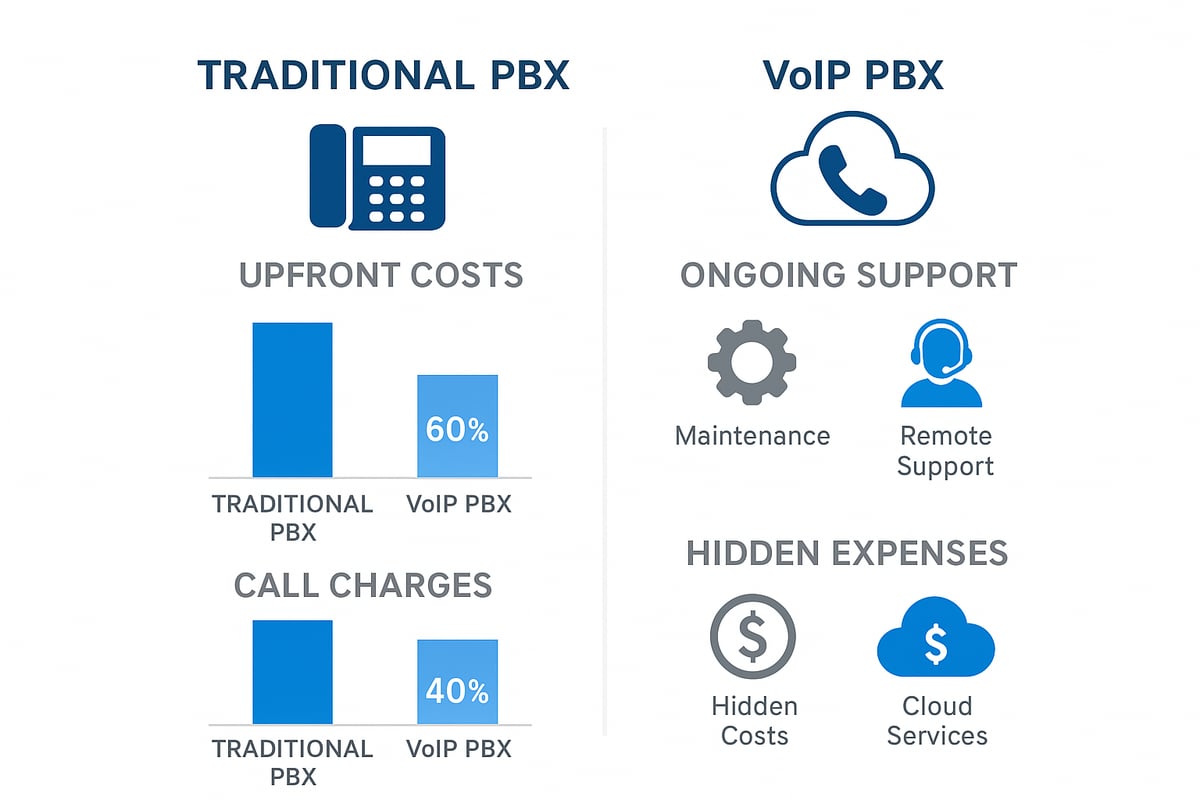
The initial investment for a traditional PBX is substantial. Businesses must purchase hardware, run new wiring, and pay for professional installation. Physical switchboards and desk phones are required, which quickly adds up.
In contrast, a voip pbx system offers lower startup costs, especially if you choose a cloud-hosted solution. On-premise VoIP may need some hardware, but it's still less than legacy PBX. Many providers advertise "easy set up" and "DIY admin," reducing installation fees.
For example, companies can save up to 60 percent on setup by switching to a voip pbx system. This makes VoIP especially attractive for startups and growing businesses needing to control capital expenses.
Ongoing Maintenance and Support
Maintenance is another critical area where costs diverge. Traditional PBX systems demand routine hardware servicing, technician visits, and periodic replacements. These recurring expenses can strain IT budgets, especially as equipment ages.
A voip pbx system streamlines support with remote troubleshooting and automatic software updates. Most issues can be resolved offsite, reducing downtime and eliminating the need for frequent technician calls. Some providers even bundle support into monthly plans, making costs predictable.
Traditional PBX owners often face expensive annual support contracts, while those with a voip pbx system enjoy lower, more manageable maintenance outlays.
Call Charges and Scalability Costs
Call charges can vary widely between systems. With traditional PBX, businesses pay per line and face high long-distance or international fees. Scaling up means buying new hardware and paying for installation, which quickly becomes costly.
A voip pbx system typically offers flat-rate or usage-based pricing, with much lower international rates. Adding or removing users is simple and flexible, requiring just a few clicks. This is invaluable for companies with fluctuating staffing needs.
Studies show that switching to a voip pbx system can reduce call costs by up to 70 percent, making it a smart choice for cost-conscious organizations.
Hidden Costs and Total Cost of Ownership
Hidden costs can undermine the initial savings of any system. Traditional PBX users may encounter surprise expenses from hardware failures, vendor lock-in, or mandatory upgrade cycles. These can make the total cost of ownership much higher than anticipated.
A voip pbx system may require bandwidth upgrades or involve ongoing SaaS subscription fees. However, these costs are usually transparent and easier to manage. Many businesses appreciate breaking free from "expensive multi-year contracts" and gaining flexibility.
For a detailed analysis of cost factors, see this PBX vs VoIP: How to Compare and Choose a Phone System guide. Over time, the long-term savings and flexibility of a voip pbx system often outweigh the hidden costs of legacy solutions.
Features and Functionality in 2025: What Businesses Need
In 2025, the features and functionality of your business phone system can make or break productivity. The differences between a traditional PBX and a voip pbx system are more pronounced than ever. Companies are demanding more than just reliable voice calling - they expect a unified platform that supports modern workflows. Below, we break down the core and advanced capabilities that define the best systems this year.
Core Features: Voice, Messaging, Video
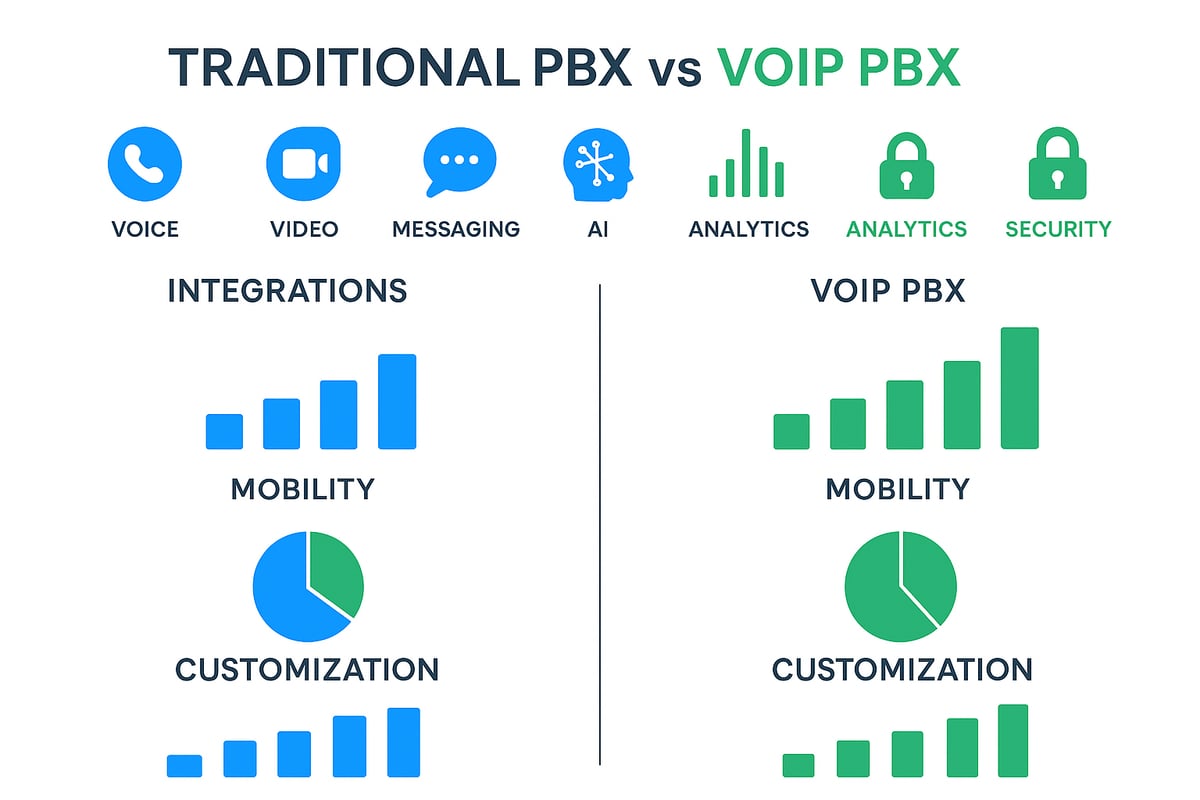
A traditional PBX system typically offers voice calling, voicemail, and basic conferencing. These features have served businesses well, but expectations have shifted. A voip pbx system brings not only voice calls but also SMS, video conferencing, and instant messaging into a single platform.
This unified approach lets teams communicate across channels without switching tools. For example, 3CX offers world-class mobile and web apps, allowing users to join video meetings or chat from any device. Nextiva provides a unified communications suite combining calls, texts, and video, ideal for hybrid teams.
With a voip pbx system, employees can collaborate in real time, regardless of location. This flexibility supports remote work and boosts team productivity. Traditional PBX, limited to desk phones, is now outpaced by these modern communication tools.
Advanced Capabilities: Integrations, Mobility, AI
The modern voip pbx system excels in advanced integrations, mobility, and artificial intelligence. Unlike traditional PBX, which is often limited to on-premise hardware, VoIP solutions connect seamlessly with CRM platforms, project management tools, and workflow automation software.
Providers like Nextiva offer AI-powered platforms that analyze call data, automate routine tasks, and deliver actionable insights. 3CX includes AI analytics to optimize customer interactions and improve service quality. Sales teams can benefit from CRM-phone integration, automatically logging calls and tracking customer journeys.
Mobility is another major advantage. With mobile apps and web clients, a voip pbx system supports remote and hybrid work without sacrificing functionality. For an in-depth look at top providers and their features, see the Best VoIP solutions for 2025.
User Experience and Accessibility
A voip pbx system transforms user experience by offering browser-based dashboards, intuitive mobile apps, and remote management. Employees and administrators can access their communication tools from anywhere, using any device.
This flexibility is critical as businesses shift to hybrid and remote work models. After 2020, the need for accessible, cloud-based phone solutions has surged. Traditional PBX systems, which tether users to physical desk phones, cannot match the ease and convenience provided by modern VoIP platforms.
With a voip pbx system, onboarding new users or making changes is straightforward, often requiring just a few clicks. This user-centric approach increases adoption and keeps teams connected in any environment.
Security and Compliance Features
Security remains a top concern for any business phone system. A voip pbx system typically offers robust security measures, such as end-to-end encryption, multi-factor authentication, and compliance with regulations like GDPR and HIPAA.
Providers like Nextiva and 3CX highlight their security certifications, reassuring businesses that their data is protected. In contrast, traditional PBX systems rely mainly on physical security and offer limited digital controls.
Advanced monitoring and automated alerts help detect suspicious activity quickly. The voip pbx system’s ability to adapt to new compliance standards makes it a future-proof choice for regulated industries and data-sensitive organizations.
Customization and Flexibility
Customization sets the voip pbx system apart from legacy solutions. Businesses can tailor call flows, set up interactive voice response (IVR) menus, and configure intelligent call routing based on business hours or departments.
APIs and workflow engines, like those offered by 3CX, enable deeper integration with other business tools. This DIY administration empowers IT teams to make changes without waiting for external technicians.
Traditional PBX systems often require manual configuration and lack flexibility. In contrast, a voip pbx system adapts quickly to organizational changes, supporting business agility and growth.
Real-Time Analytics and Monitoring
One of the most valuable features of a voip pbx system is real-time analytics. Modern platforms provide dashboards that display call metrics, user activity, and performance indicators.
Supervisors can monitor calls live, identify bottlenecks, and make data-driven decisions on the fly. Nextiva’s real-time dashboards, for example, give managers instant visibility into team performance.
Traditional PBX systems offer only basic call logs, limiting insights. With a voip pbx system, businesses gain transparency and control, driving continuous improvement in communication processes.
Scalability, Deployment, and Global Reach
Modern businesses require communication systems that can expand or contract as needs shift, support a distributed workforce, and connect global offices efficiently. Here is how traditional PBX and a voip pbx system compare across scalability, deployment, and international reach.
Scaling Up or Down: Adding/Removing Users
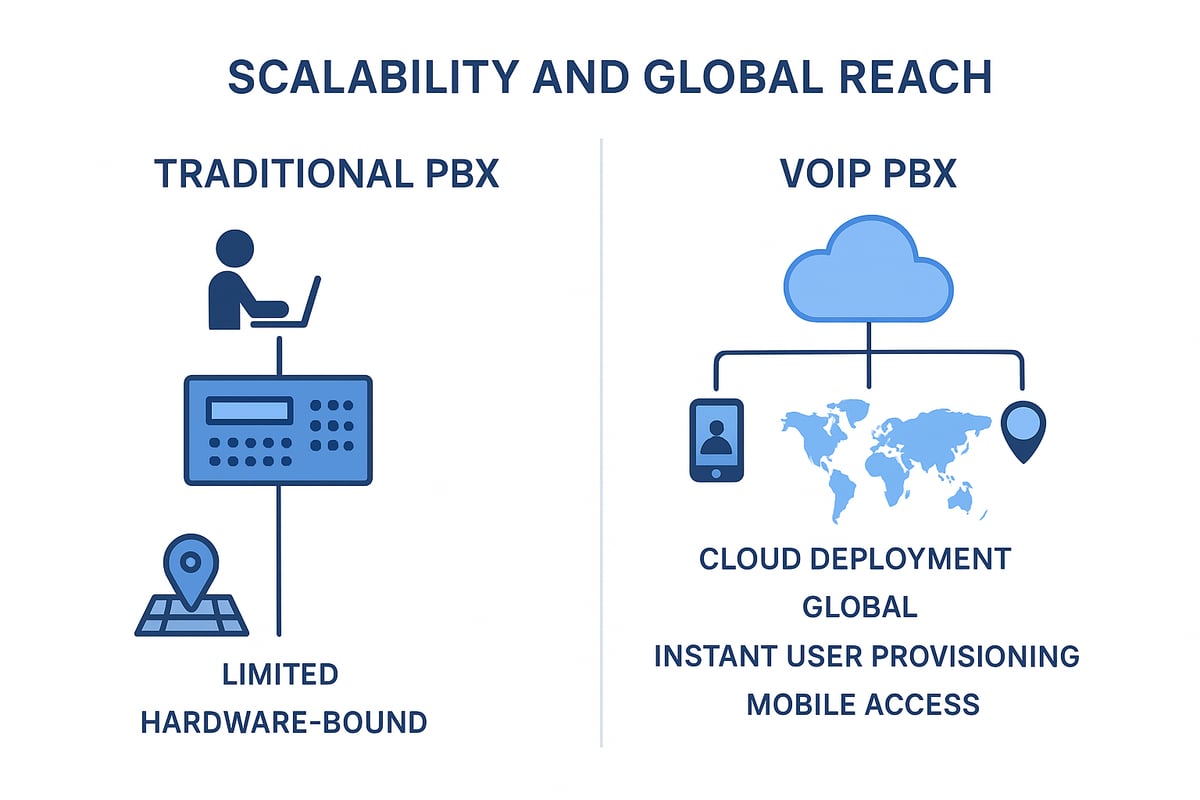
Traditional PBX systems often struggle to keep pace with business growth or seasonal fluctuations. Adding users typically means installing new hardware, rewiring, and waiting for technician visits. This process is not only slow but also costly.
A voip pbx system, in contrast, makes scaling seamless. Businesses can instantly provision or remove users through a web dashboard, with no physical limitations. Pay-as-you-grow pricing ensures you only pay for what you need. This flexibility is essential for companies with dynamic staffing, such as those experiencing seasonal spikes or rapid expansion.
- Instant user provisioning
- No need for on-site technicians
- Scalable for seasonal or project-based teams
Voip pbx system solutions offer a clear advantage in supporting agile business models.
Deployment Models: On-Premise, Cloud, Hybrid
Deployment options are a critical consideration. Traditional PBX is limited to on-premise setups, locking businesses into specific locations. In contrast, a voip pbx system can be deployed on-premise, in the cloud, or as a hybrid, adapting to various business needs.
Cloud-hosted voip pbx system deployments enable businesses to operate without maintaining physical infrastructure, reducing IT burden and enabling remote access. Hybrid models allow gradual migration from legacy systems. For a deeper dive into implementation options, see this business internet phone system guide.
- On-premise: full control, higher maintenance
- Cloud: minimal hardware, remote-ready
- Hybrid: combines benefits, eases transition
Choosing the right model ensures alignment with your current and future business strategies.
Remote Work and Mobile Workforce Support
The rise of remote work has shifted expectations. Traditional PBX, tied to physical locations, offers limited mobility and remote access. This hinders productivity for distributed teams.
A voip pbx system empowers employees to work from anywhere using mobile apps, softphones, or browser clients. Calls, voicemails, and messaging are accessible on any device, supporting a mobile-first approach. This is crucial for organizations with remote or hybrid teams.
- Mobile/web apps for global access
- Unified communications across devices
- Supports flexible work arrangements
With a voip pbx system, your workforce stays connected and responsive, regardless of location.
International and Multi-Site Operations
Expanding globally is challenging with traditional PBX. Each location often requires its own system, leading to complex and costly interconnections. Communication between offices can be inefficient.
A voip pbx system consolidates communications across all sites, enabling a single platform for global connectivity. Businesses can assign local numbers in over 190 countries, route calls seamlessly, and manage operations centrally.
| Feature | Traditional PBX | VoIP PBX System |
|---|---|---|
| Global Numbers | Separate per site | Unified, global |
| Management | Local, manual | Centralized, web |
| Cost | High | Lower |
For multinational organizations, a voip pbx system unlocks true global reach and operational efficiency.
Reliability, Security, and Business Continuity
Ensuring your business communication is reliable, secure, and resilient is vital in 2025. The choice between a traditional PBX and a voip pbx system can have a profound impact on your company's ability to operate without interruption, protect sensitive data, and recover quickly from unexpected events.
System Uptime and Redundancy
A voip pbx system typically leverages cloud infrastructure, offering built-in redundancy across multiple data centers. This means if one server fails, another instantly takes over, ensuring minimal downtime. Cloud providers often guarantee uptimes of 99.99 percent or higher.
In contrast, traditional PBX relies on on-premise hardware, which creates a single point of failure. Disasters like power outages, fire, or flooding can render the entire communication network inoperable. Hosted PBX solutions, however, include features like automatic failover and disaster recovery, so businesses remain reachable even during local outages.
Here is a quick comparison:
| Feature | VoIP PBX System | Traditional PBX |
|---|---|---|
| Redundancy | Geo-redundant cloud | None/limited |
| Uptime Guarantee | 99.99 percent + | Hardware reliant |
| Disaster Recovery | Built-in | Manual/none |
Call Quality and Network Dependence
Traditional PBX systems are known for stable call quality, as they operate independently from the internet. Voice signals travel via dedicated copper lines, so local network issues rarely affect communication.
A voip pbx system, however, depends on internet bandwidth and network stability. The good news is that modern broadband and fiber connections have drastically improved VoIP reliability. Providers like 3CX recommend a minimum bandwidth per call, helping businesses plan for optimal performance. As a result, call quality now often matches or exceeds that of legacy analog systems, provided the network is properly configured.
For organizations with reliable internet, the benefits of a voip pbx system far outweigh the limitations, especially as remote work becomes standard.
Security Threats and Mitigation
Security is a top priority for any communication system. A voip pbx system faces risks such as hacking, phishing, and denial of service attacks. To counter these threats, providers implement encryption, multi-factor authentication, and real-time monitoring. Leading vendors undergo regular security audits and comply with industry standards to protect data and calls.
Traditional PBX systems, while less susceptible to cyberattacks, are still vulnerable to wiretapping and physical breaches. They lack advanced digital security features, making them less suitable for modern compliance requirements.
For a deeper dive into how security, maintenance, and management differ, see PBX and VoIP: Top 10 Crucial Differences in 2025.
Disaster Recovery and Business Continuity
A voip pbx system excels in disaster recovery. Cloud-based backups ensure that, even if physical offices are inaccessible, employees can reroute calls and access their communication tools from anywhere. Automatic failover keeps operations running during outages, and remote access allows teams to stay productive.
Traditional PBX requires manual backups and recovery, which can be slow and prone to data loss. Physical damage often results in prolonged downtime, impacting business continuity. The flexibility and resilience of a voip pbx system make it a clear choice for organizations prioritizing uninterrupted service and rapid recovery.
Real-World Use Cases and Industry Adoption Trends
Business adoption of the voip pbx system continues to accelerate, transforming how organizations of all sizes communicate. From nimble startups to global enterprises, the shift from traditional PBX is driven by cost savings, flexibility, and the growing need for remote collaboration. Below, we examine how different industries and sectors are leveraging modern PBX technologies to meet unique operational demands.
SMBs and Startups
For SMBs and startups, the voip pbx system offers a powerful combination of affordability and scalability. Unlike traditional PBX, which demands a hefty initial investment and on-site hardware, VoIP solutions can be deployed rapidly with minimal capital outlay.
Take, for example, a tech startup scaling its workforce across multiple locations. By adopting a voip pbx system, it gains instant access to features like mobile apps, video conferencing, and automated call routing. This enables flexible work arrangements and supports global expansion without the complexity of legacy systems.
Common benefits for SMBs and startups include:
- Low entry costs
- Seamless onboarding for remote staff
- Easy integration with business tools
As a result, the voip pbx system has become the go-to choice for new and growing businesses.
Enterprises and Large Organizations
Enterprises often face the challenge of balancing legacy infrastructure with modern demands. Many large organizations still operate traditional PBX equipment but are gradually migrating to a voip pbx system for unified communications.
A global retailer, for instance, might deploy a hybrid solution to integrate existing desk phones with cloud-based VoIP services. This approach preserves prior investments while unlocking advanced features like contact center analytics and multi-site connectivity. According to PBX vs VoIP: Comparing Phone Systems for Modern Businesses, enterprises increasingly value the flexibility and cost efficiency of VoIP as they modernize operations.
Key enterprise adoption trends include:
- Hybrid deployments bridging old and new systems
- Centralized management across offices
- Improved analytics and reporting
The voip pbx system enables enterprises to future-proof their communications while controlling costs.
Regulated Industries and Compliance
Heavily regulated sectors, such as healthcare and finance, require strict compliance and secure communications. The voip pbx system addresses these needs with features designed for data protection and auditability.
For example, a healthcare provider transitioning from analog PBX to a voip pbx system gains encrypted calls, secure messaging, and comprehensive audit trails. These capabilities help meet requirements like HIPAA or GDPR, which traditional PBX cannot fully support.
Notable compliance-focused features include:
- End-to-end encryption
- Detailed call logs and audit trails
- Role-based access controls
By adopting a voip pbx system, regulated industries enhance security and maintain compliance with evolving standards.
Future Trends: AI, Analytics, and Unified Communications
Looking ahead, the voip pbx system is at the forefront of innovation in business communications. AI-powered features, such as intelligent call routing and real-time analytics, are becoming standard. Unified communications platforms now integrate voice, video, chat, and collaboration tools into a single interface.
A multinational firm, for instance, might use conversational analytics to monitor customer sentiment and optimize call flows. As highlighted in PBX Systems Explained: The 2025 Guide To Smarter Business Phones, the VoIP PBX market is projected to grow steadily, driven by these advanced capabilities.
Emerging trends shaping adoption:
- AI-driven call management
- Cross-channel communication integration
- Cloud-based scalability
The voip pbx system continues to evolve, empowering businesses to stay agile and competitive in a digital-first world.
Decision-Making Guide: How to Choose the Right PBX for Your Business
Selecting the right PBX solution requires a structured approach. With so many options available, understanding your company's unique requirements is essential. This guide will help you evaluate core considerations, migration challenges, and provider criteria for your next step.
Assessing Business Needs and Priorities
Begin by analyzing your organization's size, communication patterns, and future growth objectives. For companies planning to expand, the scalability and integration capabilities of a voip pbx system are crucial. Consider whether remote work, unified communications, or mobile access are priorities.
Evaluate your current infrastructure and budget. Are you prepared for an upfront investment or do you prefer predictable, recurring costs? Review integration needs with CRM or collaboration tools. For foundational knowledge, IP telephone systems explained offers insights into the technology behind VoIP PBX solutions.
A clear understanding of your needs ensures a smoother selection process and avoids costly missteps.
Migration Considerations and Challenges
Transitioning from a traditional PBX to a voip pbx system involves careful planning. Assess staff readiness for new technology and allocate time for training. Gradual migration, such as running both systems in parallel, can minimize disruptions.
Data migration is a key factor - ensure all call records, user settings, and extensions transfer seamlessly. Budget for potential bandwidth upgrades, especially if remote work is a priority. Address compatibility with existing hardware to avoid unnecessary expenses.
A phased approach allows businesses to adapt at their own pace while leveraging the benefits of a modern voip pbx system.
Evaluating Providers and Support
When choosing a voip pbx system provider, prioritize reliability and transparent pricing. Investigate security certifications and compliance capabilities to safeguard sensitive communications. Responsive customer support, including real-time analytics and remote troubleshooting, is vital for ongoing success.
Compare integration options with your existing tools and assess the ease of system management. Leading vendors like Nextiva and 3CX offer comprehensive feature sets, but always verify support responsiveness and service-level agreements.
A thorough evaluation helps you avoid vendor lock-in and ensures your voip pbx system meets both current and future needs.
Checklist for 2025 PBX Selection
Use this checklist to guide your decision:
- Does it support on-premise, cloud, or hybrid deployment?
- Is the voip pbx system compatible with existing tools?
- What is your budget for setup and ongoing costs?
- Is the solution ready for remote and hybrid work?
- Can it scale easily with business growth?
- Are security and compliance standards met?
A structured checklist ensures all critical factors are addressed before making your final choice.
After exploring the differences between VoIP PBX and traditional PBX systems in 2025, it's clear that reliable, modern communication is essential for every business. If you're ready to move beyond the limits of outdated setups and want to experience seamless global connectivity, real time analytics, and enterprise grade SMS verification, VoIPStore makes the transition straightforward. You can optimize costs, scale effortlessly, and support your team wherever they work. Why wait to future proof your communications? Take the first step today with a platform built for reliability and speed - Start now!
Ready to receive a verification code on a real mobile number?
Browse services