Wholesale VoIP Guide 2025: Essential Insights for Success
Discover expert strategies and key trends in wholesale VoIP for 2025. Learn how to choose providers, ensure compliance, and drive business growth with confidence.
Iacopo Bonandi, Founder & CEO
November 1, 2025The global wholesale VoIP market is on track to exceed $194.5 billion by 2024. This explosive growth signals a transformative shift in how businesses communicate worldwide.
For telecom professionals and enterprises, mastering wholesale VoIP is critical for cost savings, scalability, and global expansion. This guide offers actionable insights, expert strategies, and real-world examples to help you thrive.
Explore the latest market trends, business models, technology essentials, provider selection criteria, regulatory requirements, and future opportunities. Use this guide to confidently navigate the wholesale VoIP landscape and unlock your potential in 2025.
Understanding Wholesale VoIP: Models, Market, and Growth Opportunities
Wholesale VoIP has become the backbone of modern telecom, enabling organizations to deliver large-scale, flexible voice services across the globe. This section will break down how wholesale VoIP operates, its core services, market growth, business models, and the key benefits driving its rapid adoption.
Defining Wholesale VoIP and Its Core Functions
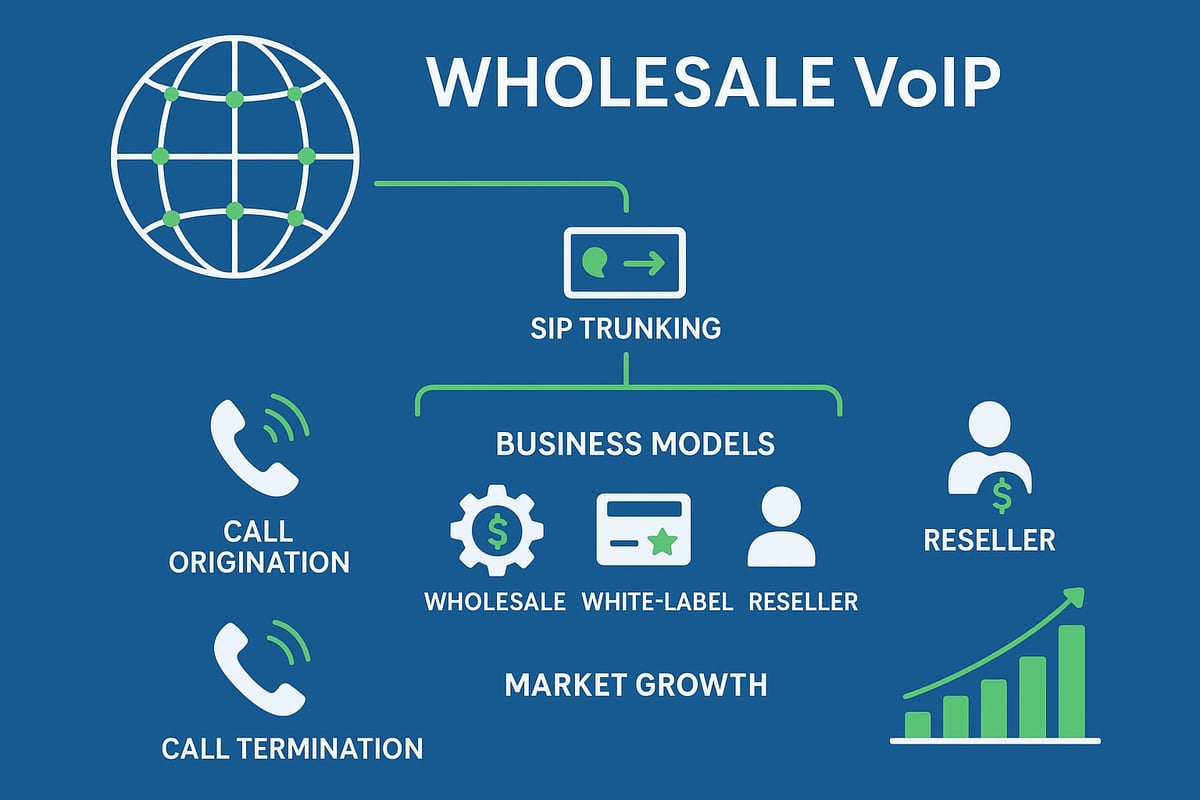
Wholesale VoIP refers to the bulk provision of voice services by carriers to resellers, managed service providers, and telecom companies. Unlike retail VoIP, which targets end-users, wholesale VoIP focuses on enabling other businesses to offer voice solutions under their own brands.
There are several models in the wholesale VoIP space. Standard wholesale VoIP involves carriers selling minutes in bulk to businesses who then serve their own customers. White-label VoIP allows partners to rebrand the service as their own, maintaining control over pricing and customer experience. Reseller VoIP is typically more turnkey, with less control but faster go-to-market options.
Core services include:
- Voice origination and termination (starting and ending calls globally)
- SIP trunking (connecting IP PBXs to the public telephone network)
- Carrier interconnection (direct links between networks)
A typical call flow starts with call origination from a local number, routing across interconnected networks, and global termination. For example, a global MSP leverages wholesale VoIP to provide seamless international calling for its enterprise clients, enhancing connectivity and reducing costs.
Market Growth, Trends, and Industry Data
The wholesale VoIP market is experiencing remarkable expansion. According to recent Global VoIP Market Growth Projections, the market is expected to surpass $194.5 billion by 2024, with a compound annual growth rate of 10.9 percent. This surge is driven by the rise of remote work, ongoing digital transformation, and the widespread adoption of unified communications as a service (UCaaS).
Regions such as North America, Western Europe, and Asia-Pacific are leading in wholesale VoIP adoption, with emerging markets in Africa and Southeast Asia showing rapid growth. The industry is shifting from traditional telephony to internet-based communications, allowing businesses to expand globally without heavy infrastructure investments.
As organizations seek cost-effective, scalable, and reliable voice solutions, wholesale VoIP is quickly becoming the preferred model for both established carriers and new entrants.
Business Models and Revenue Streams
Wholesale VoIP operates under several business models, each with unique revenue streams. The wholesale model involves selling large volumes of call minutes at discounted rates, enabling partners to set their own pricing. In contrast, retail VoIP targets end-users directly, usually with higher margins but lower volume.
Resellers and white-label partners earn by offering value-added services such as SIP trunking, international DIDs, and advanced routing. Carriers can also generate recurring revenue from monthly service fees, volume-based pricing, and bundled offerings.
For instance, a reseller might package SIP trunking alongside cloud PBX and analytics, creating a steady subscription-based revenue flow. This approach not only diversifies income but also increases customer retention through added value.
| Model | Target Customer | Revenue Source |
|---|---|---|
| Wholesale | MSPs, carriers, resellers | Bulk minute sales, volume fees |
| White-label | Resellers, MSPs | Subscription, branding margin |
| Retail | End-users, businesses | Direct service fees |
Key Arguments and Insights
Wholesale VoIP stands out for its scalability, flexibility, and cost efficiency. Providers can quickly scale up or down based on demand, making it ideal for businesses with fluctuating call volumes or seasonal needs.
White-label models offer strong branding potential and customer ownership, empowering partners to build their own market presence. Meanwhile, the collaborative nature of wholesale VoIP creates mutual benefits: providers gain broader distribution, resellers expand their portfolios, and end clients enjoy tailored, affordable voice services.
As the market matures, those who leverage wholesale VoIP’s unique advantages will be best positioned to capture new growth opportunities and outperform traditional telecom models.
Technology Essentials: SIP Trunking, Infrastructure, and Quality Assurance
A robust technology foundation is essential for any wholesale voip business aiming to thrive in a competitive landscape. Modern voice networks demand flexible, scalable, and reliable infrastructure that can adapt as markets and customer needs evolve.
SIP Trunking and Its Role in Wholesale VoIP
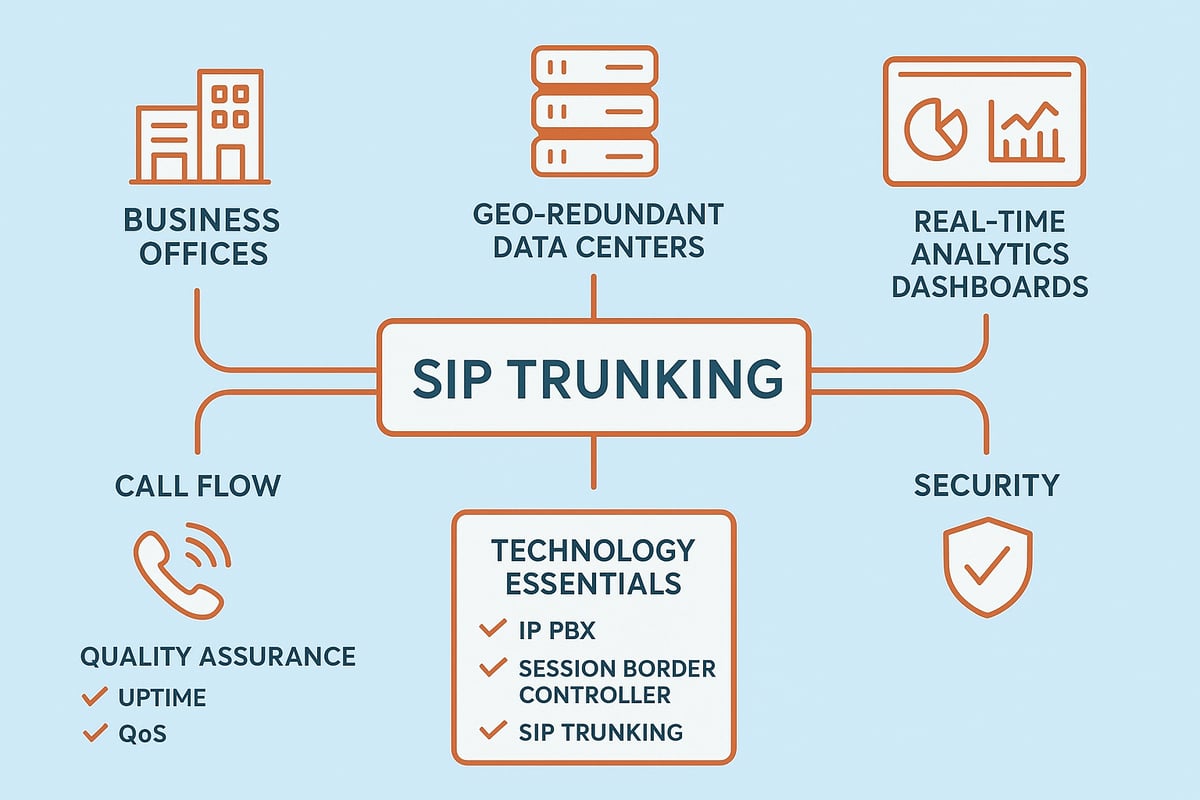
SIP trunking is at the core of wholesale voip, acting as the bridge between traditional telephony and IP-based communications. Unlike analog lines, SIP trunks use the internet to transmit voice traffic, enabling businesses to consolidate voice and data over a single network.
With SIP trunking, companies gain the flexibility to adjust voice capacity in real time. For example, seasonal businesses can increase their trunk allocation during peak months and scale back when demand drops, avoiding wasted resources. This dynamic scaling is a major advantage for wholesale voip providers serving diverse client bases.
SIP trunking also supports advanced routing, direct inward dialing, and seamless integration with unified communications platforms. For a deeper dive into this technology, review the SIP trunking for business guide.
Infrastructure Requirements and Network Reliability
The backbone of any successful wholesale voip operation is a resilient infrastructure. Geo-redundant data centers and multiple points of presence (POPs) across regions ensure that voice traffic remains available, even if one location faces an outage.
Network reliability hinges on high-availability architecture, direct interconnects with Tier-1 carriers, and failover systems. These features guarantee that calls are routed efficiently, minimizing latency and maximizing uptime. Quality of Service (QoS) protocols prioritize voice packets, protecting call clarity even during network congestion.
Consider a provider who deploys automatic failover between data centers. If one facility goes offline, traffic instantly shifts to a backup, preventing business disruptions and ensuring consistent service for wholesale voip customers.
| Infrastructure Element | Benefit |
|---|---|
| Geo-redundant Data Centers | High availability, disaster recovery |
| Multiple POPs | Reduced latency, local presence |
| Direct Carrier Interconnects | Global reach, better call quality |
| QoS Monitoring | Consistent voice performance |
Monitoring, Analytics, and Advanced Features
Continuous monitoring is vital to uphold the standards expected in wholesale voip. Real-time analytics allow providers to track call quality, usage patterns, and detect anomalies such as fraud or network abuse.
Integration with CRM, call center, and business intelligence tools empowers businesses to gain actionable insights from their communications data. Security protocols, including encryption and multi-factor authentication, protect sensitive information and maintain regulatory compliance.
A practical example involves a wholesale voip provider using analytics to optimize routing. By analyzing call completion rates and costs, they can dynamically adjust routes, reducing expenses while maintaining high quality.
Key advanced features include:
- Real-time fraud detection and alerts
- Customizable call routing rules
- API access for integration with business platforms
- Automated reporting and dashboards
Key Arguments and Insights
Superior technology infrastructure sets leading wholesale voip providers apart from the competition. Investing in advanced monitoring, redundancy, and analytics tools ensures not only high client satisfaction but also operational efficiency.
Compliance with data security standards such as HIPAA and GDPR has become non-negotiable. Providers who prioritize these aspects build trust with enterprise clients and tap into lucrative, regulated markets.
In summary, the right mix of SIP trunking, reliable infrastructure, and intelligent monitoring forms the backbone of a successful wholesale voip strategy. This combination enables businesses to deliver scalable, secure, and high-quality voice services that meet the evolving demands of the digital communications landscape.
Step-by-Step Guide: How to Succeed in Wholesale VoIP in 2025
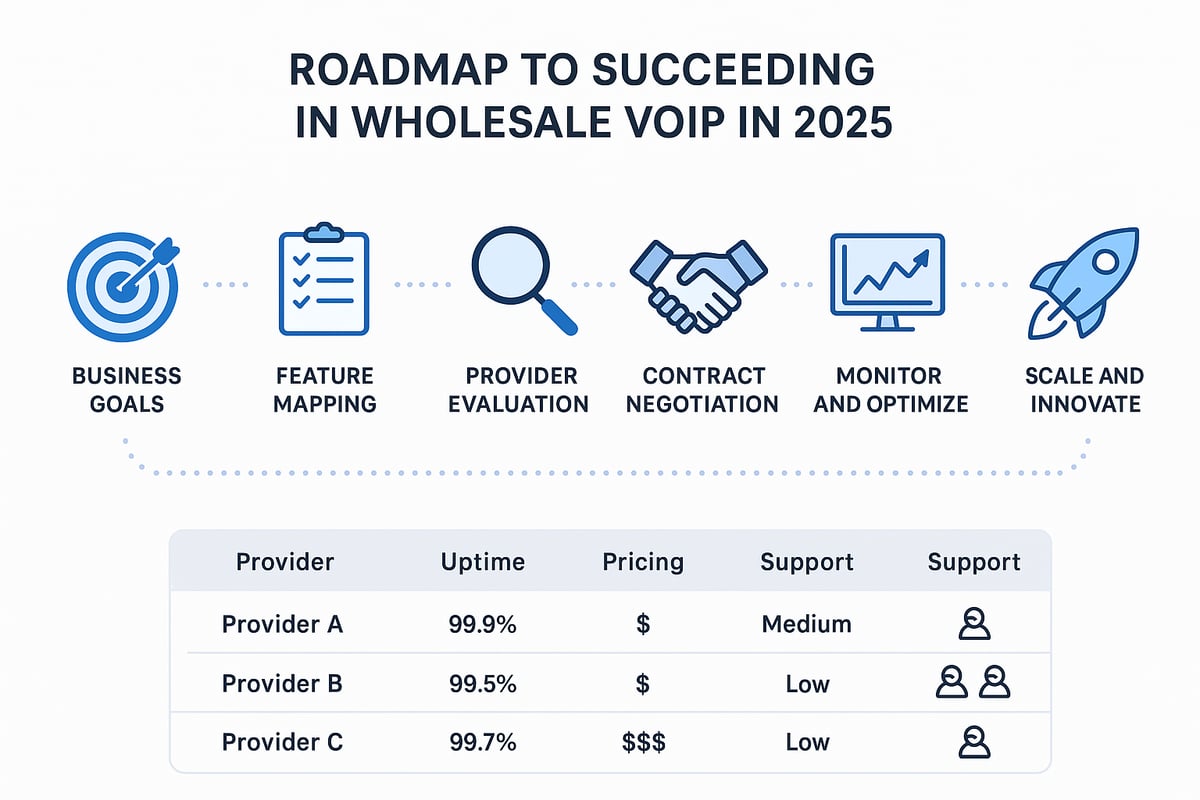
Embarking on your wholesale voip journey in 2025 requires a strategic, methodical approach. This step-by-step guide will help you navigate the market, build robust infrastructure, and achieve sustainable growth. Each step below is designed to boost your chances of success and maximize profitability in this dynamic industry.
Step 1: Assess Your Business Goals and Target Market
Begin by clarifying your position in the wholesale voip ecosystem. Are you a reseller, managed service provider, carrier, or enterprise client? Each role shapes your service scope and long-term objectives.
Define whether you'll focus on domestic markets, international connectivity, or niche sectors such as healthcare or finance. For example, a managed service provider targeting hospitals should prioritize HIPAA-compliant solutions. Understanding your goals ensures you align every subsequent decision with your desired business outcomes.
Step 2: Map Out Required Features and Capabilities
Next, identify the essential features your clients require. Must-have options for most wholesale voip operations include international DID numbers, advanced call routing, fraud prevention, and real-time analytics.
Consider what value-added services set you apart, such as SMS, video calling, or unified communications. For instance, offering bundled voice and SMS can attract SaaS platforms seeking a holistic communication package. This tailored approach helps you address diverse client needs and creates new revenue streams.
Step 3: Evaluate and Compare Potential Providers
Choosing the right wholesale voip partner is critical. Research each provider’s reputation, infrastructure strength, and customer feedback. Compare their direct carrier relationships, network redundancy, and technical support.
A structured comparison table can clarify differences:
| Provider | Uptime SLA | Pricing Model | Support Hours | Value-added Services |
|---|---|---|---|---|
| Provider A | 99.999% | Per-minute | 24/7 | SMS, Analytics |
| Provider B | 99.99% | Subscription | Business | CRM Integration |
For a comprehensive evaluation process, consult the Wholesale VoIP provider guide to streamline your selection and avoid common pitfalls.
Step 4: Negotiate Contracts and SLAs
After shortlisting providers, review their contracts and service level agreements in detail. Focus on uptime guarantees, call quality metrics, and penalty clauses for service disruptions.
Examine data ownership, compliance with regulations, and termination terms. For mission-critical clients, negotiate custom SLAs that reflect their operational needs. Solid agreements safeguard your business interests and build trust with your customers in the wholesale voip market.
Step 5: Set Up and Test Your Infrastructure
Once agreements are in place, deploy the necessary hardware and software. This typically includes IP PBXs, session border controllers, and integration APIs for seamless operation.
Conduct test calls across multiple regions to verify call quality and network stability. Use analytics tools to monitor call completion rates and quickly resolve any issues. A reliable infrastructure forms the backbone of your wholesale voip offering.
Step 6: Launch, Monitor, and Optimize
With your infrastructure ready, begin routing live traffic. Closely monitor call quality, latency, and operational costs using real-time dashboards.
Analyze usage trends and adjust routing strategies to reduce expenses and improve reliability. Regular optimization ensures consistent performance and strengthens your competitive edge in the wholesale voip industry.
Step 7: Scale and Innovate
As your business gains traction, expand your service portfolio. Add features like SMS, video communications, and omnichannel support to meet evolving client demands.
Invest in automation, white-label portals, and advanced analytics to streamline operations. Stay informed about regulatory changes and technology trends, positioning your wholesale voip business for long-term growth and innovation.
Choosing the Right Wholesale VoIP Provider: 10 Essential Criteria
Selecting the right wholesale voip provider is a strategic decision that shapes your business’s reliability, profitability, and customer satisfaction. The following criteria will guide you in making an informed, confident choice for your 2025 operations.
1. Define Your Service Requirements and Feature Set
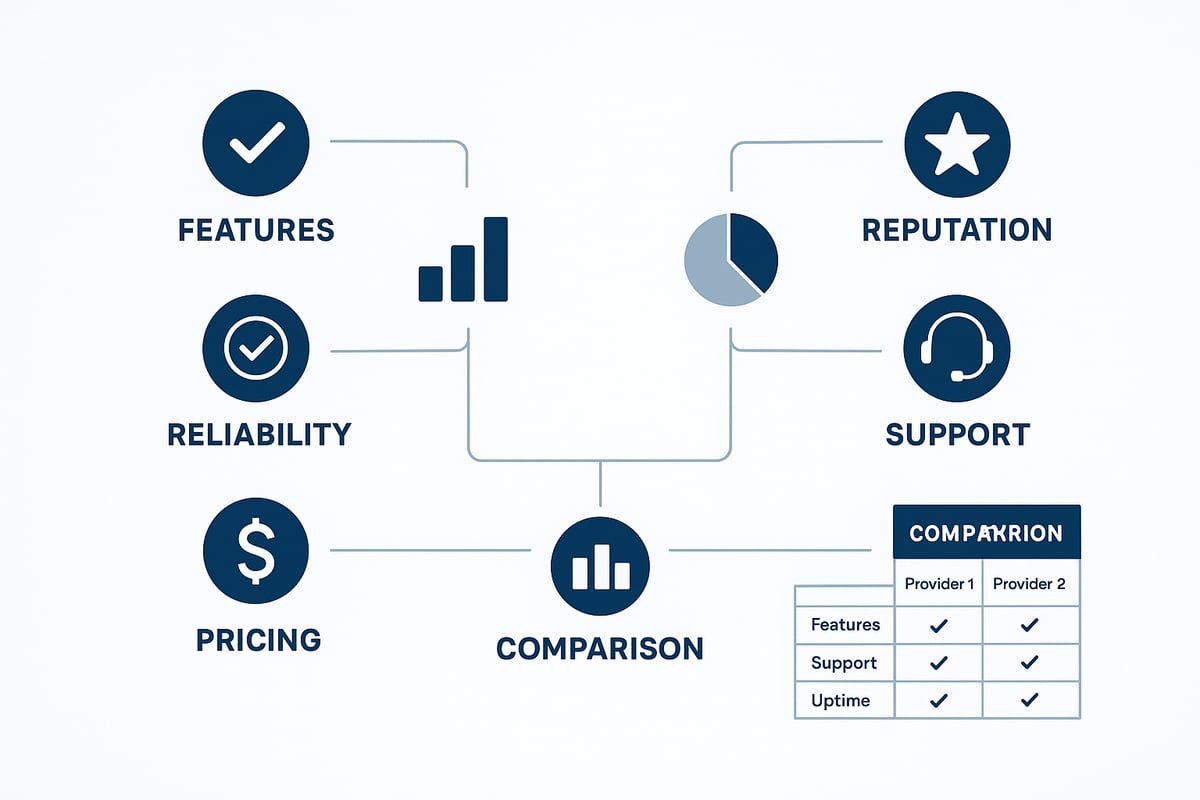
Begin your wholesale voip journey by clearly identifying your business’s core and advanced needs. Map out which features are essential for your clients, such as international Direct Inward Dialing (DID), intelligent call routing, fraud protection, and robust analytics.
Consider modular offerings that allow you to scale as customer demands evolve. For instance, if you serve BPO clients, prioritize advanced call center capabilities like call queuing and CRM integrations.
Anticipate future requirements, such as video conferencing or SMS integration, to ensure your provider can adapt as your wholesale voip business grows.
2. Evaluate Provider Reputation and Market Standing
A provider’s reputation is a strong indicator of their reliability and service quality. Investigate company history, leadership team, and any industry awards or recognitions.
Seek out customer testimonials, third-party reviews, and case studies to assess real-world performance. Avoid providers with negative feedback on reliability or unresolved support issues. For a comprehensive review of top business VoIP services, visit Best VoIP business solutions.
By choosing a reputable wholesale voip partner, you can minimize risk and build long-term client trust.
3. Assess Network Reliability and Voice Quality
Network architecture is the backbone of any wholesale voip solution. Look for providers offering geo-redundant data centers, multiple points of presence (POPs), and direct interconnects with Tier-1 carriers.
Assess their Quality of Service (QoS) monitoring and ensure they offer Service Level Agreements (SLAs) that guarantee high uptime and call quality.
For example, providers that promise 99.999% uptime and real-time quality dashboards demonstrate a commitment to reliability. This ensures your wholesale voip services remain consistent and dependable.
4. Analyze Training, Support, and Onboarding
Effective onboarding and ongoing support are critical for successful wholesale voip implementation. Choose providers with 24/7 technical support, structured onboarding programs, and a comprehensive knowledge base.
Access to live chat, email, and phone support allows your team to resolve issues quickly. Some providers also offer sales and technical training for resellers, enabling you to maximize the value of your wholesale voip offerings.
Evaluate the support process by reviewing response times and escalation procedures before making a decision.
5. Understand Pricing Models and Total Cost of Ownership
Transparent pricing is vital for maintaining healthy profit margins in wholesale voip. Review the provider’s pricing models, including per-minute rates, subscription options, and volume discounts.
Be vigilant about hidden fees, such as setup charges or surcharges for international routes. Favor providers who bundle value-added services, like fraud protection or analytics, at no extra cost.
By calculating the total cost of ownership, you can ensure your wholesale voip business remains competitive and profitable.
6. Compare Multiple Providers Systematically
A structured comparison approach helps you identify the best fit for your wholesale voip needs. Use a matrix to evaluate features, pricing, support, and reliability across multiple vendors.
| Provider | Features | Pricing | Uptime SLA | Support |
|---|---|---|---|---|
| Provider A | Advanced | $$ | 99.999% | 24/7 Phone |
| Provider B | Basic | $ | 99.9% | Email Only |
| Provider C | Modular | $$$ | 99.99% | Chat & Phone |
Assess at least three to five providers before final selection. This ensures you find operational advantages, such as superior billing systems or customizable customer portals, for your wholesale voip business.
7. Review Contract Terms and Data Privacy
Before signing, scrutinize all contract details. Ensure SLAs cover uptime, quality, and penalties for non-compliance. Review termination clauses, indemnification, and data ownership terms closely.
Confirm that your wholesale voip provider complies with regulations like GDPR or HIPAA, especially when serving clients in highly regulated industries.
Negotiating favorable terms and understanding data privacy policies will protect your business and foster long-term partnerships.
Regulatory Compliance, Security, and Risk Management in Wholesale VoIP
Navigating the regulatory landscape is essential for any wholesale voip provider. Compliance is not just a box to check, but a foundation for building trust and expanding internationally. As the wholesale voip market grows, providers must adapt to a complex web of global and regional rules.
Navigating Global Regulatory Requirements
Wholesale voip businesses must comply with a patchwork of international, regional, and national regulations. The most prominent include GDPR for EU data privacy, HIPAA for US healthcare communications, and CCPA for California consumer rights. Telecom-specific laws also vary by country, impacting data retention and lawful access.
Providers serving multiple regions must understand each market’s legal obligations. For example, GDPR mandates strict data protection and breach notification, while HIPAA requires encryption and audit controls for healthcare clients. Failure to comply can result in severe penalties and reputational damage.
Regional differences add another layer of complexity. Serving clients in the EU demands different compliance strategies than operating in the US or Asia. According to the International Wholesale Voice Carrier Market Analysis, adapting to these evolving requirements is critical for sustainable growth in the wholesale voip sector.
Security Protocols and Fraud Prevention
Security is a non-negotiable priority in wholesale voip operations. Providers must implement robust encryption for call data, ensuring both signaling and media streams are protected from interception. Authentication protocols, such as SIP TLS and SRTP, safeguard communications between endpoints.
Real-time fraud detection is another essential tool. Systems that monitor call patterns can quickly identify and block suspicious activity, reducing the risk of toll fraud and revenue loss. Automated alerts and proactive intervention help maintain service integrity.
A layered security approach also includes firewalls, intrusion prevention, and regular vulnerability assessments. By adopting these measures, wholesale voip providers demonstrate their commitment to customer data protection and regulatory compliance.
Risk Management Best Practices
Risk management in wholesale voip is about preparing for the unexpected. Contractual safeguards such as liability clauses, indemnification, and adequate insurance protect against financial fallout from service disruptions or regulatory violations.
Disaster recovery planning is equally important. Geo-redundant infrastructure, backup power, and failover systems ensure business continuity even during outages. Providers should routinely test their response to incidents, updating plans as threats evolve.
A proactive stance on risk management reassures clients and strengthens provider reputation. For example, using geo-redundant data centers enables uninterrupted service delivery, which is a significant selling point in the competitive wholesale voip landscape.
Industry Trends and Future Compliance Challenges
The compliance landscape for wholesale voip is not static. Increasing scrutiny on privacy and data sovereignty is driving new regulations, especially in emerging markets. Providers must anticipate these changes and adjust their processes accordingly.
Artificial intelligence is beginning to play a role in compliance monitoring, automating tasks such as anomaly detection and audit trail analysis. Staying ahead of these trends will be crucial for maintaining a competitive edge and ensuring regulatory alignment.
Looking forward, wholesale voip providers should invest in continuous education and agile compliance systems. This proactive approach will help them navigate the challenges of tomorrow’s regulatory environment and capitalize on new market opportunities.
The Future of Wholesale VoIP: Innovations, Challenges, and Opportunities
The future of wholesale voip is bright, defined by rapid innovation, evolving customer needs, and new growth opportunities. As technology continues to advance, industry leaders must navigate emerging trends to stay competitive. Below, we explore the forces shaping the wholesale voip landscape in 2025 and beyond.
Emerging Technologies and Market Shifts
Artificial intelligence is transforming wholesale voip, enabling smarter call routing, advanced speech analytics, and automated network management. AI can optimize call quality and cost in real time, adapting to network conditions instantly. The rise of APIs and self-service developer tools empowers businesses to integrate wholesale voip into custom workflows, while omnichannel platforms combine voice, SMS, video, and chat for seamless communication.
According to VoIP Telephony Market Trends and Forecast, the global VoIP market is set to grow from $48.27 billion in 2025 to $155.75 billion by 2034. This explosive growth signals an era of opportunity and innovation for wholesale voip providers and resellers.
Expanding Global Reach and Interoperability
Wholesale voip is expanding into new regions, unlocking opportunities in Africa, Southeast Asia, and other underserved markets. Providers are investing in local infrastructure and direct interconnects to ensure reliable service where demand is rising fastest. Seamless interoperability with both legacy and next-generation networks is critical to support diverse client needs.
As global reach increases, wholesale voip providers must ensure compatibility across platforms and regulatory environments. This expansion drives more resilient, scalable, and accessible voice services for enterprises worldwide.
Evolving Customer Demands and Service Expectations
Customer expectations for wholesale voip are evolving quickly. Enterprises now demand unified communications platforms that integrate voice, SMS, analytics, and video. Instant onboarding, self-service portals, and detailed usage analytics have become baseline requirements.
To remain competitive, wholesale voip providers are bundling services and offering analytics-driven insights. For example, businesses seek real-time data on call quality and usage patterns to fine-tune operations and deliver superior experiences to their end users.
Competitive Landscape and Differentiation
The wholesale voip market is crowded, with new entrants and established players competing for market share. Differentiation is essential. Providers are focusing on white-label solutions, bespoke offerings, and exceptional customer support to stand out.
Building brand equity and customer loyalty is a top priority. Success stories often feature providers who deliver unique value, such as advanced fraud protection, dedicated account management, or customized billing solutions. These factors help set wholesale voip businesses apart from the competition.
Anticipated Challenges and Solutions
Margin pressure remains a significant challenge as competition intensifies in wholesale voip. Regulatory uncertainty and compliance requirements add further complexity, especially in global markets. Security concerns, including fraud and data breaches, are also top of mind.
To address these issues, providers are leveraging automation to control operational costs and investing in real-time security monitoring. Staying agile and proactive is essential for overcoming obstacles in the wholesale voip ecosystem.
Opportunities for Growth and Innovation
New revenue streams are emerging for wholesale voip providers. Value-added services like SMS verification, IoT communications, and unified communications platforms offer recurring income and customer stickiness. Strategic partnerships can help expand service portfolios and reach new audiences.
For those interested in innovative business models, VoIP reseller opportunities highlight how resellers can diversify into new segments and capitalize on market trends. By embracing change, wholesale voip businesses can secure long-term growth and industry leadership.
As you explore the key strategies and trends shaping wholesale VoIP in 2025, it’s clear that the right technology partner makes all the difference. With VoIPStore, you gain access to reliable global communication, real time analytics, and seamless integration with over 100 services - enabling you to scale confidently and optimize costs. Whether you’re a developer or an enterprise, robust infrastructure and dedicated support are essential for navigating the evolving market. Ready to put these insights into action and elevate your communication solutions? Start now!
Ready to receive a verification code on a real mobile number?
Browse services