Bandwidth VoIP Guide: Essential Insights for 2025
Master bandwidth VoIP for 2025 with key trends, expert strategies, and compliance tips. Optimize business communications and future proof your VoIP setup today.
Iacopo Bonandi, Founder & CEO
October 23, 2025Business communication is transforming fast, and 2025 is set to be a landmark year for bandwidth voip technology. As organizations adapt to new digital realities, the need for robust, reliable, and high-quality voice communications has never been greater.
This guide offers essential insights into bandwidth voip fundamentals, the latest VoIP trends, and proven strategies for optimizing business communications. You will discover how bandwidth voip works, what drives its rapid adoption, and what your organization must know to stay ahead.
Explore the basics of bandwidth for VoIP, understand how calls traverse modern networks, review key 2025 trends, and learn best practices for ensuring compliance, security, and future-ready performance. Ready to optimize your communications and empower your business? Read on for expert guidance tailored for the year ahead.
Understanding Bandwidth and VoIP Fundamentals
Voice over Internet Protocol, or VoIP, has become a cornerstone for modern business communication. With the rise of remote and hybrid work, understanding how bandwidth voip solutions operate is more important than ever. Companies rely on seamless, high-quality calls to connect teams and clients globally.
What is VoIP and How Does It Work?
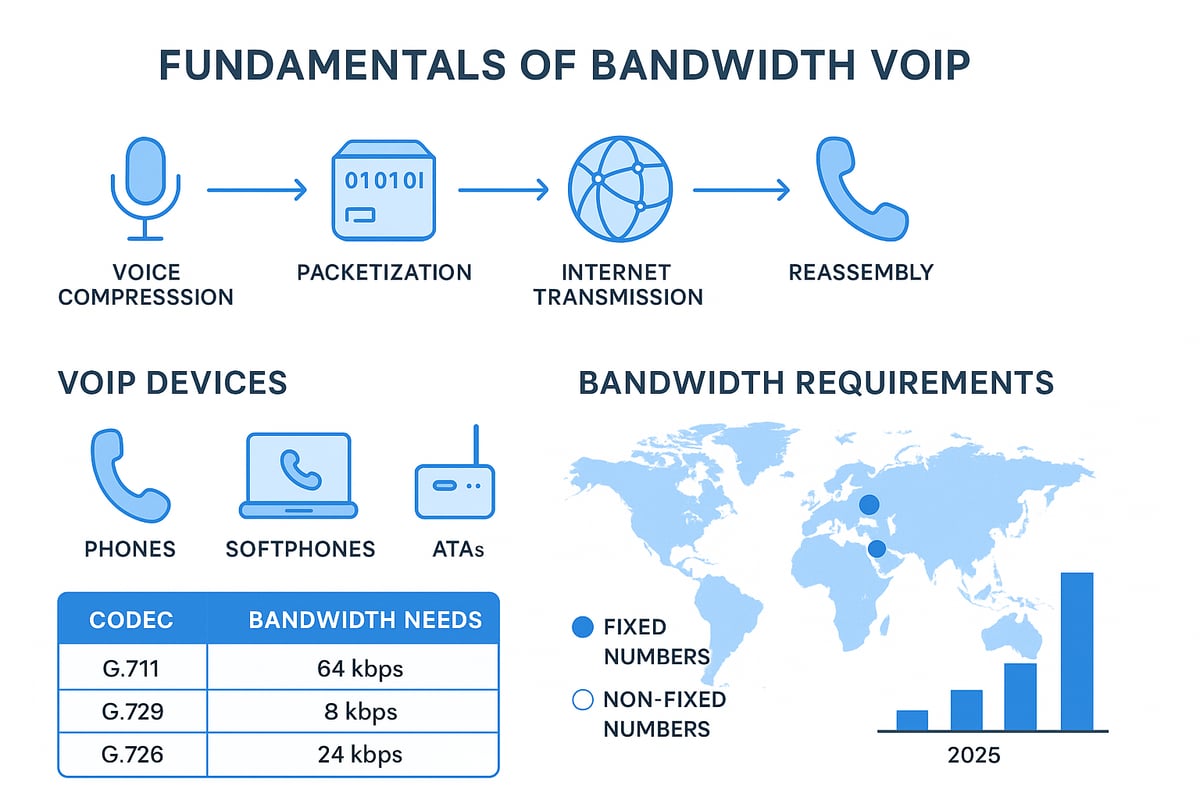
VoIP allows voice communication to travel over the internet as data packets, replacing traditional phone lines. When you speak into a VoIP-enabled device, your voice is digitized, compressed, and split into packets. These packets travel across the internet and are reassembled at the recipient’s end. This process makes bandwidth voip systems highly efficient and flexible.
You can use VoIP through various devices, such as dedicated VoIP phones, softphones (software-based phones on computers or mobiles), and analog terminal adapters (ATAs) for legacy handsets. Popular platforms like Microsoft Teams and RingCentral integrate VoIP with collaboration tools, making them ideal for remote teams.
VoIP adoption is accelerating as businesses move to the cloud and traditional ISDN lines are phased out in Europe. Features like CNAM and caller ID ensure calls are easily identified, supporting compliance and user experience. By enabling seamless remote and hybrid work, bandwidth voip technology is reshaping global business communication.
Bandwidth: Definition and Importance for VoIP
Bandwidth is the rate at which data travels over a network, measured in kilobits per second (kbps) or megabits per second (Mbps). For bandwidth voip, sufficient bandwidth directly impacts call quality, latency, and reliability. If bandwidth is limited, calls may suffer from jitter, dropped connections, or poor audio.
High-definition (HD) calls, for example, require more bandwidth than standard calls. Without enough bandwidth, packet loss can occur, damaging the clarity of conversations. Proper allocation is essential for business-grade reliability.
For a deeper analysis of call quality and technical requirements, see VoIP Bandwidth Requirements Explained. This resource is valuable for IT teams planning bandwidth voip deployments at scale.
Types of VoIP Numbers: Fixed vs Non-Fixed
VoIP numbers are categorized as fixed or non-fixed. Fixed VoIP numbers are linked to a physical location, such as a corporate office or campus. These numbers are ideal for organizations with centralized offices and provide easier emergency services integration.
Non-fixed VoIP numbers, in contrast, are virtual and not tied to a specific address. This flexibility supports global teams, remote employees, and businesses needing a local presence in multiple regions. For example, direct inward dialing (DID) lets companies assign non-fixed numbers to international staff, streamlining communications.
With the growing adoption of cloud-based systems, non-fixed numbers are increasingly common in bandwidth voip solutions. They are especially useful for supporting a distributed workforce and global expansion.
Core VoIP Bandwidth Requirements for 2025
Understanding the technical needs of bandwidth voip is vital as demand increases. A standard voice call using the G.711 codec typically needs 85-100 kbps per call. Compressed codecs like G.729 or Opus require less - around 8-32 kbps per call - making them ideal for optimizing bandwidth usage.
Video and multi-party calls consume significantly more bandwidth. As organizations adopt more HD voice and video, average bandwidth requirements are rising. To future-proof your network, plan for scalability and growth, ensuring your bandwidth voip infrastructure can handle expanding communication needs.
Key Bandwidth Challenges in VoIP Deployments
Modern businesses depend on reliable bandwidth voip solutions to ensure seamless communication. Yet, as organizations scale, several challenges can disrupt call quality and reliability. Understanding these hurdles is vital for IT leaders planning robust deployments.
Common Bandwidth-Related VoIP Issues
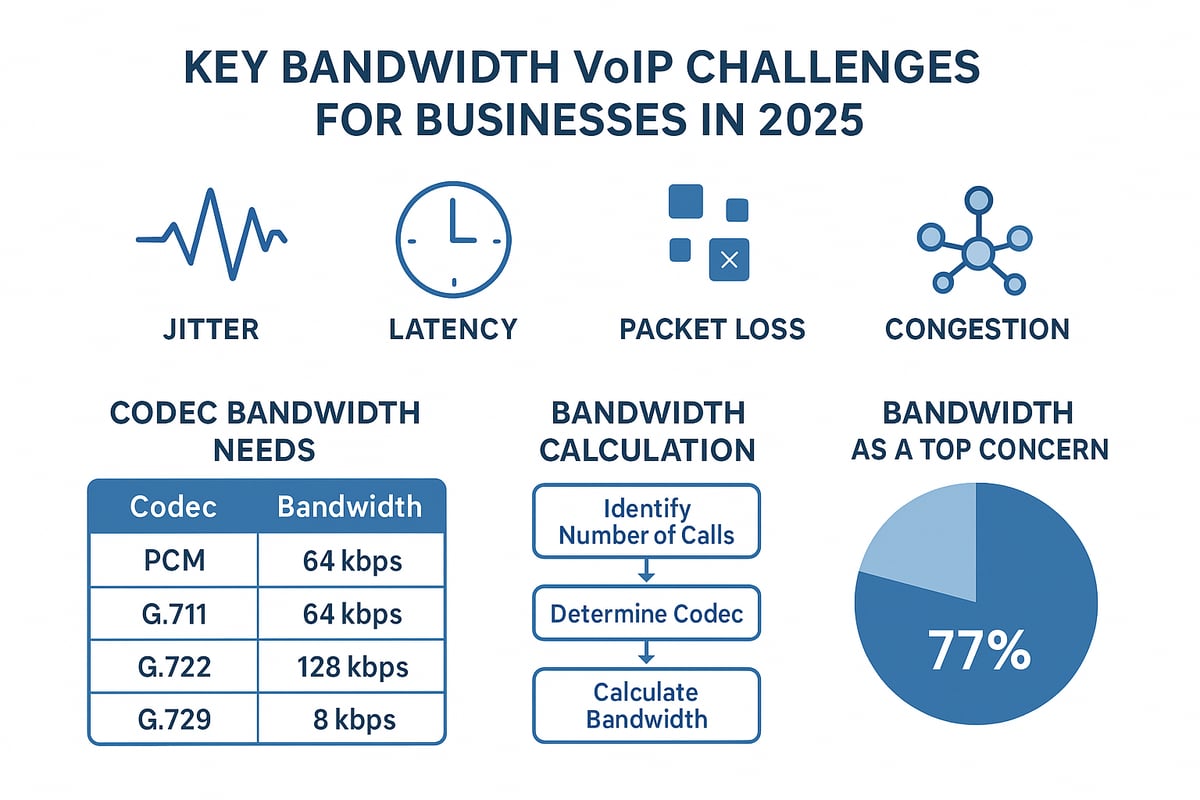
Bandwidth voip deployments often encounter technical issues that directly impact user experience. The most common problems include:
- Jitter: Variations in packet arrival times can create choppy or robotic audio. This disrupts natural conversation flow and may cause confusion.
- Latency: Delays in voice transmission make it difficult for participants to communicate in real time. High latency is especially noticeable during international or multi-party calls.
- Packet Loss: Missing data packets result in gaps, silences, or dropped calls. Even a small 1 to 2 percent packet loss can degrade bandwidth voip quality.
- Congestion: When networks are overloaded with simultaneous traffic, call quality suffers. This is a frequent issue in shared environments like remote work setups or busy offices.
| Issue | Impact on Bandwidth VoIP Calls |
|---|---|
| Jitter | Choppy, distorted audio |
| Latency | Noticeable delay in conversation |
| Packet Loss | Dropped calls, missing words |
| Congestion | Overall call degradation |
Remote employees using home networks often report these challenges, especially when multiple devices share bandwidth voip resources. Proactive management is key to minimizing these disruptions.
Factors Affecting VoIP Bandwidth Utilization
Several factors influence how efficiently bandwidth voip resources are used across an organization:
- Codec Selection: Higher compression codecs use less bandwidth but may compromise call clarity. Choices like G.729 or Opus balance efficiency and quality, while G.711 offers premium audio at higher bandwidth costs.
- Concurrent Calls: As more users make calls simultaneously, total bandwidth voip requirements increase. Failing to account for peak usage leads to performance bottlenecks.
- Network Hardware: Business-grade routers and switches are necessary to prioritize voice traffic. Inadequate equipment can cause voice packets to compete with other data, lowering quality.
- Other Network Activities: Video conferencing, large file downloads, and cloud applications compete for bandwidth voip resources, causing unpredictable spikes.
Proper planning means considering all these elements together. For a deeper dive into balancing network activities and ensuring reliable business communications, see the Business internet phone systems guide.
Bandwidth Calculation and Planning Steps
Accurate calculation is essential for successful bandwidth voip deployment. Follow these steps:
- Determine the number of concurrent calls your business expects during peak times.
- Identify the codecs in use and their respective bandwidth voip consumption per call.
- Multiply concurrent calls by per-call bandwidth to get a base estimate.
- Add a 20 to 30 percent overhead to account for network fluctuations and other activities.
For example, a business planning for 20 simultaneous calls using G.711 would require:
20 calls x 100 kbps = 2 Mbps + 30% (0.6 Mbps) overhead = 2.6 Mbps total
Regularly reassess needs as team size or call volume changes to ensure ongoing bandwidth voip optimization.
Real-World Case Studies and Statistics
Real-world data highlights the importance of early planning for bandwidth voip challenges. Enterprises migrating to cloud solutions after ISDN shutdowns in Europe have reported up to 40 percent bandwidth savings by switching to optimized codecs.
According to industry reports, 70 percent of enterprises cite bandwidth voip as a top concern when deploying new systems. Early assessment and proactive management help organizations prevent costly downtime and unplanned upgrades.
Bandwidth voip performance is a cornerstone of business success in 2025. Staying informed and adaptable ensures communications remain clear and reliable as demands grow.
Bandwidth Optimization Strategies for VoIP
Optimizing bandwidth voip is fundamental for delivering high-quality communications as business needs evolve in 2025. Proactive strategies ensure reliability, reduce costs, and support growth, especially as call volumes and video usage expand.
Best Practices for Efficient Bandwidth Usage
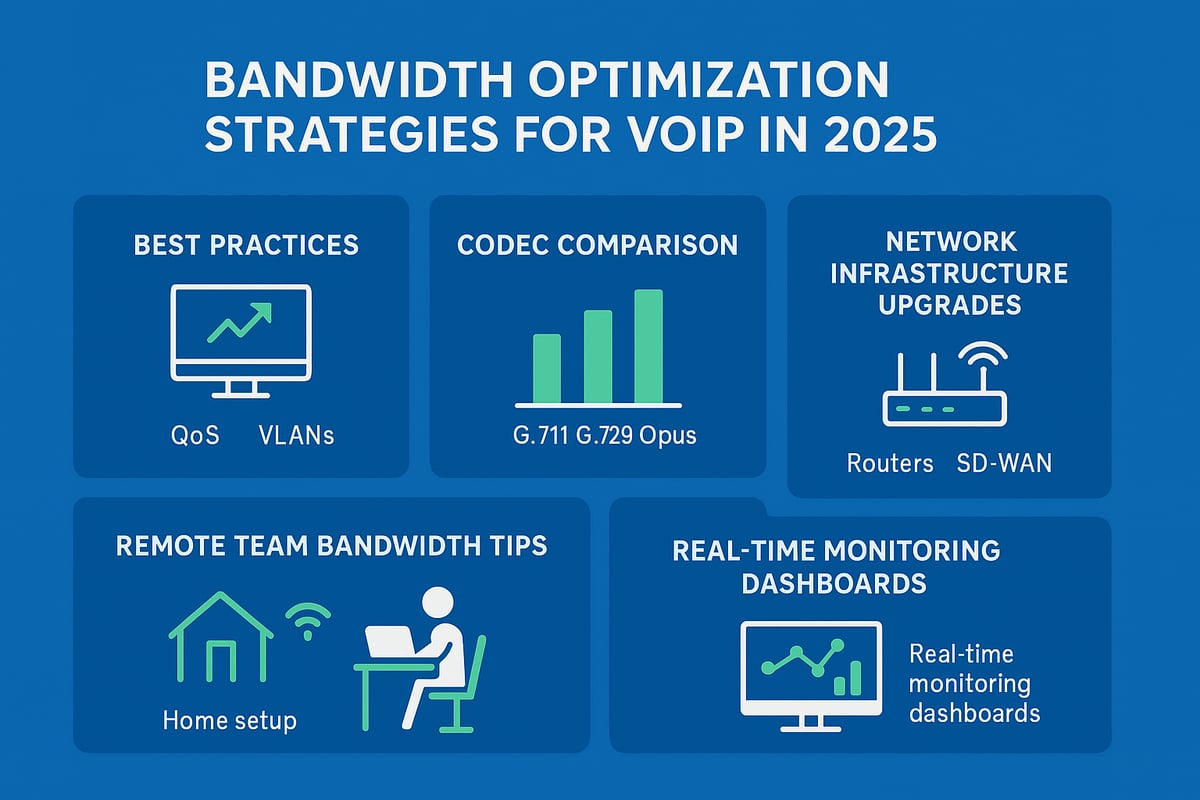
To get the most from your bandwidth voip investment, implement foundational best practices. Prioritize VoIP traffic using Quality of Service (QoS), which allocates network resources and minimizes packet loss. Segregate voice and data traffic by setting up VLANs, reducing congestion and interference.
Regular monitoring is key. Use analytics dashboards to track bandwidth voip usage and identify potential bottlenecks. Schedule heavy data transfers, like backups, during off-peak hours to preserve call quality. For businesses seeking bandwidth-efficient VoIP, evaluating Best VoIP solutions for business can help align technology with these strategies.
These measures ensure clear calls and stable connections, providing a strong foundation for business communications.
Codec Selection and Compression Techniques
Selecting the right codec is critical to bandwidth voip optimization. Codecs convert voice to digital data, and their efficiency directly impacts both quality and bandwidth requirements.
Consider the following comparison:
| Codec | Bandwidth per Call | Audio Quality | Use Case |
|---|---|---|---|
| G.711 | 85-100 kbps | HD | Office environments |
| G.729 | 8-32 kbps | Good | Remote/mobile teams |
| Opus | 8-40 kbps | High | Variable conditions |
Adaptive codecs like Opus adjust dynamically, maintaining call quality even with fluctuating bandwidth voip. Switching from G.711 to G.729 can halve requirements, freeing up capacity for more calls or additional services.
Choosing the right codec ensures optimal balance between performance and resource use.
Upgrading Network Infrastructure
Modernizing network infrastructure is essential for reliable bandwidth voip service. Invest in business-grade routers and switches that support VoIP prioritization and advanced features like SD-WAN for intelligent routing.
Confirm your internet service provider delivers sufficient upload and download speeds to support current and future call volumes. Deploy redundant connections to ensure failover in case of outages, maintaining business continuity.
Companies with hybrid teams benefit from these upgrades, experiencing less downtime and improved overall call reliability. Infrastructure investments future-proof your bandwidth voip capabilities.
Bandwidth Management for Remote and Hybrid Teams
As remote work continues to grow, effective bandwidth voip management for distributed teams is crucial. Provide clear guidelines on optimal home network setups, such as using wired connections and positioning routers in central locations.
Equip remote staff with VPN access or dedicated VoIP applications to secure and prioritize calls. Monitor remote bandwidth voip usage with management platforms, proactively addressing issues before they impact productivity.
Enterprises often supply pre-configured routers to remote employees, reducing technical hurdles and ensuring consistent call quality across locations.
Monitoring and Analytics Tools for Bandwidth
Real-time monitoring is a cornerstone of bandwidth voip optimization. Use dashboards to track bandwidth consumption and call quality, enabling IT teams to respond quickly to anomalies.
Set up alerts for spikes or drops in bandwidth voip usage, allowing for swift troubleshooting. Platforms like Nextiva offer customizable widgets for deep analytics and reporting.
Proactive monitoring helps prevent service disruptions, ensuring that business communications remain reliable and efficient.
Compliance, Security, and Regulatory Considerations
In 2025, compliance, security, and regulatory issues have become central to bandwidth voip planning. As businesses expand their reliance on cloud communications, organizations must address evolving legal requirements, security risks, and the need for resilient infrastructure. Let's break down the essential considerations every enterprise must understand to safeguard their bandwidth voip deployments.
Emergency Services and E911 Compliance
Emergency response is a critical pillar for bandwidth voip. In the United States, the RAY BAUM’s Act mandates that every VoIP endpoint must have a dispatchable location for emergency services. Fixed devices needed compliance by January 2021, while non-fixed or mobile devices had a deadline of January 2022.
To ensure compliance, businesses must:
- Update and maintain accurate location data for all VoIP numbers.
- Audit endpoints regularly, especially as teams move or expand globally.
- Train staff on proper emergency procedures with bandwidth voip systems.
Global enterprises face added complexity, juggling different country-specific regulations. Non-compliance can lead to fines and, more seriously, delayed emergency response. For bandwidth voip, proactive E911 planning ensures both safety and regulatory peace of mind.
Security Risks and Fraud Prevention in VoIP
Bandwidth voip systems are prime targets for fraud and cyberattacks, especially with the prevalence of non-fixed numbers. Threats include spoofing, robocalling, toll fraud, and unauthorized access. Protecting bandwidth voip calls demands a layered approach.
Best practices for mitigation:
- Use encrypted protocols such as SRTP and TLS for call confidentiality.
- Implement call verification and manage number reputation.
- Monitor for unusual call patterns and block suspicious numbers.
For deeper insights, explore VoIP Security and Fraud Prevention Insights to understand the latest tactics and industry strategies. As bandwidth voip adoption grows, robust fraud prevention is essential to maintain trust and service integrity.
Regulatory Trends Impacting VoIP Bandwidth
Bandwidth voip is shaped by a dynamic regulatory environment. Protocols like STIR/SHAKEN are now required in the US to authenticate caller IDs and curb spoofing. Meanwhile, data privacy laws such as GDPR and CCPA govern how call data is stored and processed.
International businesses must also navigate local emergency access rules, which can vary widely. For example, the European ISDN shutdown is accelerating cloud VoIP migration, increasing demand for compliant bandwidth voip solutions.
Staying informed about regulatory changes is vital. Enterprises should conduct regular compliance reviews and partner with providers who track global requirements to avoid costly disruptions.
Business Continuity and Disaster Recovery
Reliability is non-negotiable for bandwidth voip. Modern business continuity strategies include geo-redundant disaster recovery, automated failover, and no-maintenance windows. These measures ensure minimal downtime and uninterrupted communication, even during crises.
Key steps for robust continuity:
- Deploy redundant internet connections and backup power.
- Use real-time supervisor dashboards to monitor system health.
- Schedule regular disaster recovery drills for all staff.
With proper planning, businesses can achieve 99.99% uptime for bandwidth voip. Prioritizing continuity safeguards both productivity and reputation.
VoIP Quality Assurance and Service Level Agreements (SLAs)
Quality assurance is a cornerstone of bandwidth voip success. Clear SLAs define expectations for uptime, call quality, and support response times. Analytics tools and post-call surveys help monitor performance and identify areas for improvement.
Best practices include:
- Setting measurable targets for jitter, latency, and packet loss.
- Using real-time dashboards to track SLA compliance.
- Scheduling regular reviews with service providers.
Strong SLAs and transparent quality metrics ensure bandwidth voip remains reliable for mission-critical business operations. This instills confidence and supports long-term communication goals.
Emerging Trends and Innovations in VoIP Bandwidth for 2025
The landscape of bandwidth voip is transforming rapidly as new technologies emerge. Businesses must stay alert to these trends in 2025 to ensure their communications remain reliable and future-ready.
AI and Automation in Bandwidth Management
Artificial intelligence is now central to bandwidth voip optimization. AI-driven analytics dynamically allocate bandwidth, ensuring voice calls remain crisp even during peak usage. Automated call routing and issue resolution further reduce manual intervention.
For example, generative AI knowledge bases allow IT teams to troubleshoot network issues instantly. This automation can cut down manual bandwidth adjustments by up to 70 percent, freeing staff for higher-level tasks. As businesses scale, AI makes it possible to maintain consistent call quality without constant oversight.
By leveraging AI, companies gain the flexibility to adapt their bandwidth voip resources in real time, boosting both efficiency and scalability. This trend is set to accelerate as remote and hybrid workforces grow.
Integration with Cloud and Hybrid Platforms
Seamless integration with cloud and hybrid platforms is redefining bandwidth voip strategies. Businesses increasingly rely on services like Microsoft Teams, Zoom, Webex, and Google Voice for unified communications. API-based workflows allow for rapid deployment and flexibility.
Cloud-based VoIP solutions offer scalable bandwidth management and centralized control. For a deeper dive into the technical aspects of cloud deployments, see this overview of hosted voice and cloud VoIP. As enterprises migrate to the cloud, bandwidth voip requirements must be reassessed regularly to handle new features and user growth.
Hybrid setups combine on-premises and cloud resources, giving organizations the best of both worlds. This approach enables agile responses to shifting business needs while maintaining control over bandwidth voip allocation.
The Rise of Global and Mobile VoIP
Global expansion and mobile-first strategies are fueling the rise of non-fixed bandwidth voip solutions. Modern enterprises deploy virtual numbers to support international teams and remote workers, ensuring local presence in over 190 countries.
Mobile VoIP apps empower employees to make business calls from anywhere, using secure, optimized connections. Local number provisioning and intelligent routing ensure compliance and cost savings as organizations scale. The projected global VoIP market growth highlights the importance of adaptable bandwidth voip infrastructure for multinational operations.
To remain competitive, businesses must adopt flexible platforms that support seamless switching between regions and devices, keeping bandwidth voip performance steady worldwide.
Future-Proofing VoIP Bandwidth Investments
Preparing for the future means building bandwidth voip strategies that can handle increased video calls, AI-driven features, and IoT integration. Scalable, cloud-native solutions allow organizations to adjust bandwidth on demand as usage patterns shift.
Technologies like SD-WAN and 5G are key for future-proofing, offering intelligent routing and higher capacity. Regularly reassessing bandwidth voip needs helps prevent costly upgrades and downtime. Enterprises adopting these innovations achieve robust, reliable communications that adapt as they grow.
By investing in the right infrastructure now, businesses ensure their bandwidth voip systems remain resilient, efficient, and ready for whatever comes next.
Frequently Asked Questions About Bandwidth and VoIP
Staying informed about bandwidth voip essentials is key as businesses adapt to new communication demands. Below are answers to the most common questions organizations face about bandwidth voip and related technologies.
Can you text a non-fixed VoIP number?
Yes, you can text a non-fixed VoIP number if supported by your service provider and properly configured. Many modern platforms allow SMS to be sent and received on these numbers, making them popular for customer engagement and multi-factor authentication. For a deeper look at integrating SMS with VoIP and bandwidth voip considerations, see VoIP with texting and SMS. SMS-enabled VoIP numbers are now standard in unified communications platforms, supporting efficient business communication.
How do you find out who owns a non-fixed VoIP number?
Tracing ownership of a non-fixed VoIP number can be challenging because these numbers are not tied to a physical address. To investigate, you can check phone records or use CNAM databases for caller ID lookup. Some businesses rely on number reputation tools to verify the legitimacy of incoming calls. While bandwidth voip systems provide caller information, privacy rules often limit access to detailed ownership data for non-fixed numbers.
How do you know if a number is fixed or non-fixed?
Determining if a number is fixed or non-fixed usually requires a provider lookup or a CNAM data search. On caller ID displays, non-fixed numbers often appear identical to fixed ones. Enterprises using bandwidth voip solutions frequently run number lookups for regulatory compliance and fraud prevention. This process helps ensure that communications meet legal and security standards.
How much bandwidth does a VoIP call use?
A standard VoIP call typically uses 85 to 100 kbps per call when using the G.711 codec, while compressed codecs like G.729 can cut that requirement in half. Video or conference calls demand more bandwidth voip resources, especially as HD and multi-party usage increases. It is important to assess your network and plan for extra capacity as business communication needs expand.
What are the main benefits and drawbacks of non-fixed VoIP?
Non-fixed VoIP offers flexibility, scalability, and global reach, making it ideal for hybrid and distributed teams. Cost savings are another major benefit. However, challenges include emergency compliance and a higher risk of fraud compared to fixed numbers. The table below summarizes key points:
| Benefits | Drawbacks |
|---|---|
| Flexibility | Emergency compliance |
| Scalability | Higher fraud risk |
| Global access | |
| Cost savings |
Hybrid teams increasingly rely on non-fixed bandwidth voip numbers to support seamless mobility and international operations.
VoIPStore: Global VoIP and SMS Solutions for Enterprises
As businesses scale globally, the demand for robust bandwidth voip solutions becomes increasingly urgent. VoIPStore stands out as a trusted partner, delivering enterprise-grade VoIP and SMS services designed for reliability and scalability. With the rapid evolution of digital communications, enterprises must manage not only voice traffic but also seamless SMS verification, onboarding, and two-way messaging. VoIPStore addresses these needs by providing a unified platform that simplifies global communications and supports the bandwidth voip requirements of modern organizations.
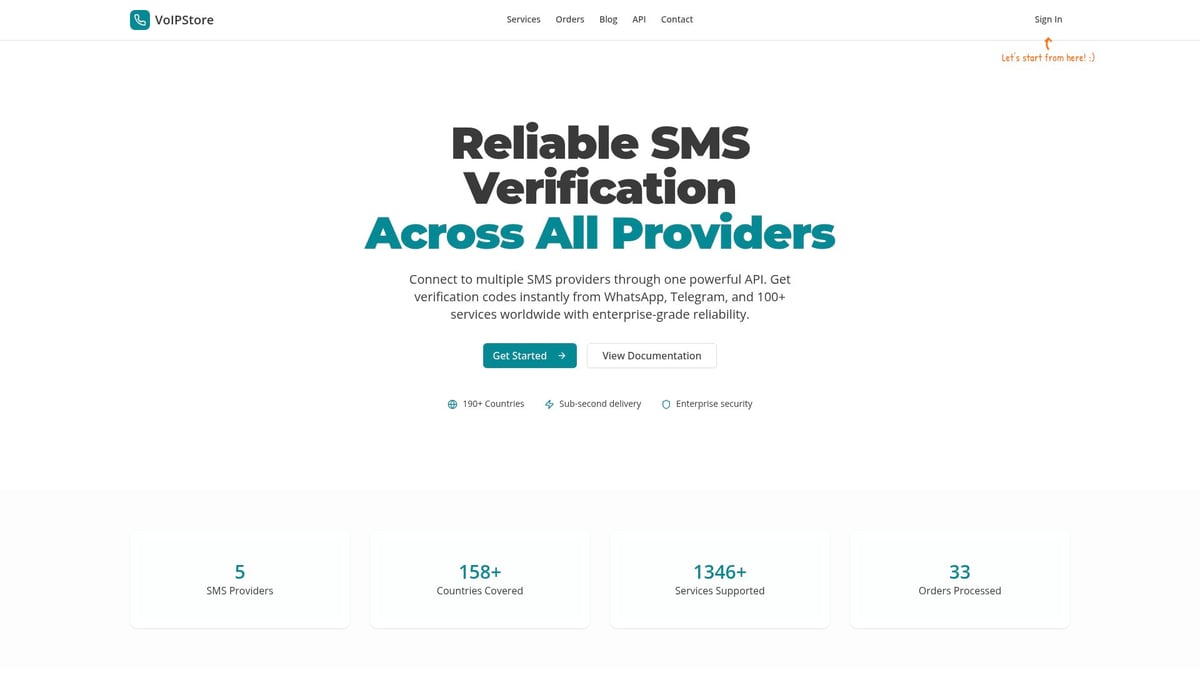
VoIPStore’s Unified SMS Verification API connects your business to over 100 popular services, including WhatsApp and Telegram, ensuring sub-second message delivery worldwide. Real-time analytics enable you to monitor bandwidth voip usage across multiple regions, optimizing both cost and performance. With coverage in more than 190 countries, VoIPStore empowers enterprises to maintain consistent communication quality and compliance at scale. According to Global VoIP Market Growth Projections, the VoIP market is on track for significant expansion, making global-ready solutions like VoIPStore essential for future-focused businesses.
Developers and enterprises benefit from VoIPStore’s streamlined integration, which unifies carrier connections through a single API. This approach minimizes complexity and reduces the operational overhead often associated with managing multiple providers. Whether you are enabling SMS verification for onboarding, supporting remote teams, or managing cross-border communications, VoIPStore’s platform ensures your bandwidth voip resources are used efficiently. The system’s real-time dashboards and intelligent routing capabilities keep you informed and in control at all times.
What sets VoIPStore apart is its combination of enterprise-grade reliability, actionable insights, and business-focused support. Features like dedicated customer service, competitive pricing, and robust security protocols help organizations maximize uptime and reduce costs. As bandwidth voip needs surge with increased HD voice, video, and IoT integration in 2025, VoIPStore’s scalable infrastructure and compliance tools ensure your communications remain resilient and future-proof. Enterprise leaders seeking to optimize global connectivity and prepare for tomorrow’s challenges will find VoIPStore an invaluable asset.
As you look ahead to 2025 and consider how bandwidth and VoIP innovations will impact your business, it’s clear that preparing now is the key to seamless, reliable communication. Whether you’re supporting remote teams, planning for global expansion, or aiming to optimize costs and performance, having the right tools and infrastructure in place makes all the difference. If you’re ready to take the next step in future proofing your communications and want access to enterprise grade VoIP and SMS services with real time analytics and global reach, you can Start now!
Ready to receive a verification code on a real mobile number?
Browse services